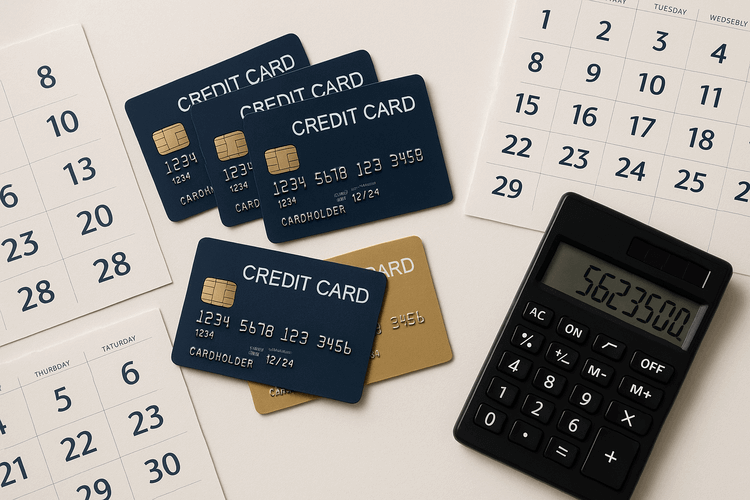
Credit card grace periods give you 21-25 days of free money when you play your cards right. Most entrepreneurs don't know you can stack these periods across multiple cards to create months of interest-free cash flow. Here's how smart business owners turn credit card timing into a cash management tool that banks don't want you to discover.
Understanding Credit Card Grace Periods
Grace periods are your secret weapon for free short-term financing. Most credit cards offer 21-25 days from your statement closing date until payment is due. During this window, you pay zero interest on new purchases.
The math is simple but powerful. Buy something on day one of your billing cycle, and you get nearly two months before paying a dime in interest. Purchase on the last day of your cycle, and you still get the full grace period after your statement closes.
Here's the catch most people miss: grace periods only work when you pay your full balance. Carry any balance from month to month, and you lose the grace period entirely. New purchases start accruing interest immediately.
How Grace Period Timing Works
Your billing cycle runs for roughly 30 days. Let's say your statement closes on the 15th of each month, with payment due on the 10th of the following month. Purchase something on January 16th, and you won't pay until March 10th—that's 53 days of free financing.
The key difference between grace periods and promotional 0% APR offers is flexibility. Grace periods reset every month if you pay in full. Promotional rates are one-time deals with strict terms and often deferred interest traps.
Your statement closing date isn't the same as your payment due date. The closing date is when your card company calculates your balance. The due date is your payment deadline. Smart players track both dates religiously. Miss this detail and your whole strategy falls apart.
The Grace Period Stacking Strategy
Grace period stacking means coordinating purchases across multiple cards to extend your interest-free borrowing window. Instead of using one card for everything, you rotate purchases based on each card's billing cycle timing.
The strategy works because each card operates on its own schedule. Card A might close statements on the 5th, Card B on the 15th, and Card C on the 25th. By timing purchases strategically, you create overlapping grace periods that can stretch 60-90 days.
Here's a real example: You need $3,000 for inventory but want to delay payment until your next big client pays. Use Card A for $1,000 on January 6th (due March 1st), Card B for $1,000 on January 16th (due March 10th), and Card C for $1,000 on January 26th (due March 20th). You've just created nearly two months of float time.
Think of it like a relay race where each card hands off the payment responsibility to the next one. If you have three cards with statement dates on the 1st, 10th, and 20th of each month, you can create a 45-75 day float cycle. Card A covers expenses from day 1-10, Card B from day 11-20, and Card C from day 21-30.
Setting Up Your Card Portfolio
Three to five cards work best for effective stacking. More cards become difficult to track, while fewer cards limit your timing options. Focus on cards with the longest grace periods—some premium cards offer up to 25 days instead of the standard 21.
Stagger your statement closing dates by 7-10 days. Call your card companies to request specific closing dates. Most issuers will accommodate this request, especially if you explain you want to spread out your monthly payments for budgeting purposes.
Credit building cards can work for this strategy, but established cards with higher limits provide more flexibility. Your total available credit across all cards should exceed your planned stacking amount by at least 50%.
Choose cards with the longest grace periods—typically 21-25 days. Some cards offer up to 25 days. Avoid cards that don't offer grace periods on new purchases if you carry any balance. Building good credit becomes crucial here since you'll need multiple approved applications.
Execution Timeline and Payment Coordination
Create a monthly calendar showing each card's statement date, due date, and optimal purchase windows. The sweet spot for purchases is typically 1-3 days after your statement closes, maximizing your grace period.
Payment timing is critical. Set up automatic payments for the full statement balance 2-3 days before each due date. Never rely on same-day payments—processing delays can kill your grace periods and trigger late fees.
Here's how the timing works in practice. Let's say Card A closes on the 1st with payments due on the 26th, Card B closes on the 10th with payments due on the 5th, and Card C closes on the 20th with payments due on the 15th. You'd make purchases on Card A from the 2nd through the 10th, switch to Card B from the 11th through the 20th, then use Card C from the 21st through the end of the month.
Build in backup payment strategies. Keep enough cash in a high-yield savings account to cover at least one full rotation of payments. This emergency fund protects you if a client payment arrives late or business income fluctuates.
Pay each card's full statement balance by the due date to maintain grace periods. Never pay just the minimum—that kills your grace period on future purchases. Set up automatic payments as a backup, but monitor them closely since your balances will be higher than usual.
Key timing rules to follow:
- Never make purchases in the last 3 days before a statement closes
- Always pay the full statement balance, never just the minimum
- Set payment reminders 7 days before each due date
- Have backup payment methods ready (different bank accounts, etc.)
Track your spending across all cards daily. High balances can hurt your credit score even if you pay on time. Keep total utilization under 30% of your combined credit limits, and individual card utilization under 10% when possible.
Risks and Limitations to Consider
Credit utilization spikes during active stacking periods can temporarily lower your credit score. If you're planning to apply for a mortgage or business loan, avoid stacking for 3-6 months beforehand. High balances across multiple cards spike your credit utilization ratio, even if you're not paying interest. This can hurt your score by 20-50 points temporarily.
Missing even one payment destroys the entire strategy. Late fees typically range from $25-40, and you'll lose grace periods on that card until you pay the full balance. Some cards also trigger penalty APRs that can reach 29.99%. You'll lose grace periods on affected cards and face interest charges on your full balance—a $5,000 balance at 24% APR costs you $100 monthly in interest alone.
The psychological risk of overspending is real. Extended payment timelines can make purchases feel "free" when they're not. Studies show people spend 12-18% more when payment timing feels abstract. Stick to planned expenses only—never use stacking as an excuse to increase your spending.
Legal and Ethical Boundaries
Grace period stacking sits in a gray area legally. You're not breaking any laws, but you're exploiting terms that weren't designed for this purpose. Some issuers might view coordinated stacking as abuse and close accounts. Read your cardholder agreements carefully—some contain language about "normal use" that could apply here.
Banks track spending patterns and can spot obvious stacking behavior. Sudden spikes in spending followed by minimum payments across multiple cards raises red flags. They might reduce credit limits or cancel cards without warning.
Financial Safeguards and Best Practices
Maintain an emergency payment fund equal to your total stacking amount. This isn't your regular emergency fund—it's specifically for covering card payments if your cash flow plan fails. Store this money in a high-yield savings account where it earns interest while staying accessible.
Monitor your credit utilization weekly during stacking periods. Keep total utilization below 30% across all cards, and ideally under 10% for the best credit score impact. Credit monitoring services can alert you to score changes.
Document everything. Track purchase dates, amounts, and expected payment dates in a spreadsheet. Set phone reminders for payment dates, and review your strategy weekly to catch potential problems early.
Create a simple spreadsheet tracking each card's statement date, due date, current balance, and grace period status. Update this weekly—no exceptions. Set phone reminders for payment dates at least three days before they're due.
Your tracking system should include:
- Statement closing dates for all cards
- Payment due dates with 3-day early warnings
- Current balances and available credit limits
- Grace period status (active/lost) for each card
- Backup payment source confirmation
Plan your exit before you start stacking. Decide in advance what situations will trigger you to stop the strategy and pay down all balances immediately. Common exit triggers include job loss, major unexpected expenses, or credit score drops below your comfort zone.
Implementation Guidelines and Alternatives
Start small with one or two cards before scaling up. Test the system with $500-1,000 to learn the mechanics without risking major financial damage. Gradually increase amounts as you master the timing.
Setting up grace period stacking requires careful planning and disciplined execution. Start by auditing your current credit cards and their statement dates. You'll want at least three cards with closing dates spread 7-10 days apart.
Common mistakes include forgetting about weekend processing delays, mixing business and personal expenses, and failing to account for statement date changes during months with different day counts. Never carry a balance from month to month, as this voids grace periods entirely.
Consider alternatives before committing to grace period stacking. Personal loans offer predictable payments and often lower rates for larger amounts. Business lines of credit provide more flexibility without the complex timing requirements.
This strategy works best for short-term cash flow gaps, not long-term financing needs. If you need money for more than 90 days, consider personal loans instead. Grace period stacking suits entrepreneurs managing irregular income or covering business expenses before client payments arrive.
For entrepreneurs managing irregular income, building an emergency fund might provide better long-term financial stability than relying on credit card timing strategies. A high-yield savings account provides immediate access without credit risks.
Grace period stacking should complement, not replace, proper emergency fund planning. Maintain at least $1,000 in readily available cash before attempting this strategy. This buffer protects against timing mistakes or unexpected expenses.
Grace period stacking can provide 45-90 days of interest-free cash float through strategic coordination of multiple credit cards. Success requires disciplined payment timing, careful credit management, and robust tracking systems to avoid costly mistakes. This strategy isn't for everyone—it works best when you've got predictable income and strong financial discipline.
Start by evaluating your current credit card portfolio and cash flow needs—this advanced strategy works best for experienced entrepreneurs who already manage credit responsibly. Remember that grace period stacking is a short-term cash flow tool, not a long-term financing strategy. If you need ongoing financing, personal loans or a business line of credit might make more sense.
Questions? Answers.
Common questions about credit card grace period stacking
Missing a payment immediately destroys your grace period on that card and can trigger late fees ranging from $25-40. You'll also lose the grace period until you pay the full balance, meaning new purchases start accruing interest immediately. Some cards may impose penalty APRs up to 29.99%. This is why having a backup payment fund equal to your total stacking amount is crucial.
Three to five cards work best for effective stacking. Fewer than three limits your timing options, while more than five becomes difficult to track and manage. Each card should have statement closing dates staggered by 7-10 days to maximize your interest-free borrowing window. Focus on cards with the longest grace periods (21-25 days) and higher credit limits.
Temporarily, yes. During active stacking periods, high balances across multiple cards can increase your credit utilization ratio, potentially lowering your score by 20-50 points. Keep total utilization under 30% of combined credit limits and individual cards under 10% when possible. Avoid stacking 3-6 months before applying for major loans. Consider using apps like Monefy to track your spending and maintain proper utilization ratios.
Yes, grace period stacking is legal, but it exists in a gray area. You're not breaking any laws, but you're using terms in ways they weren't originally designed for. Some credit card issuers might view coordinated stacking as account abuse and could close accounts or reduce credit limits. Always read your cardholder agreements for language about "normal use" that could apply to this strategy.
Several alternatives exist depending on your needs. Personal loans offer predictable payments and often lower rates for larger amounts. Business lines of credit provide flexibility without complex timing requirements. Building an emergency fund through high-yield savings accounts provides immediate access without credit risks. For long-term financing needs over 90 days, these alternatives often make more sense than grace period stacking. Tools like Monefy can help you budget and save for these emergency funds more effectively.