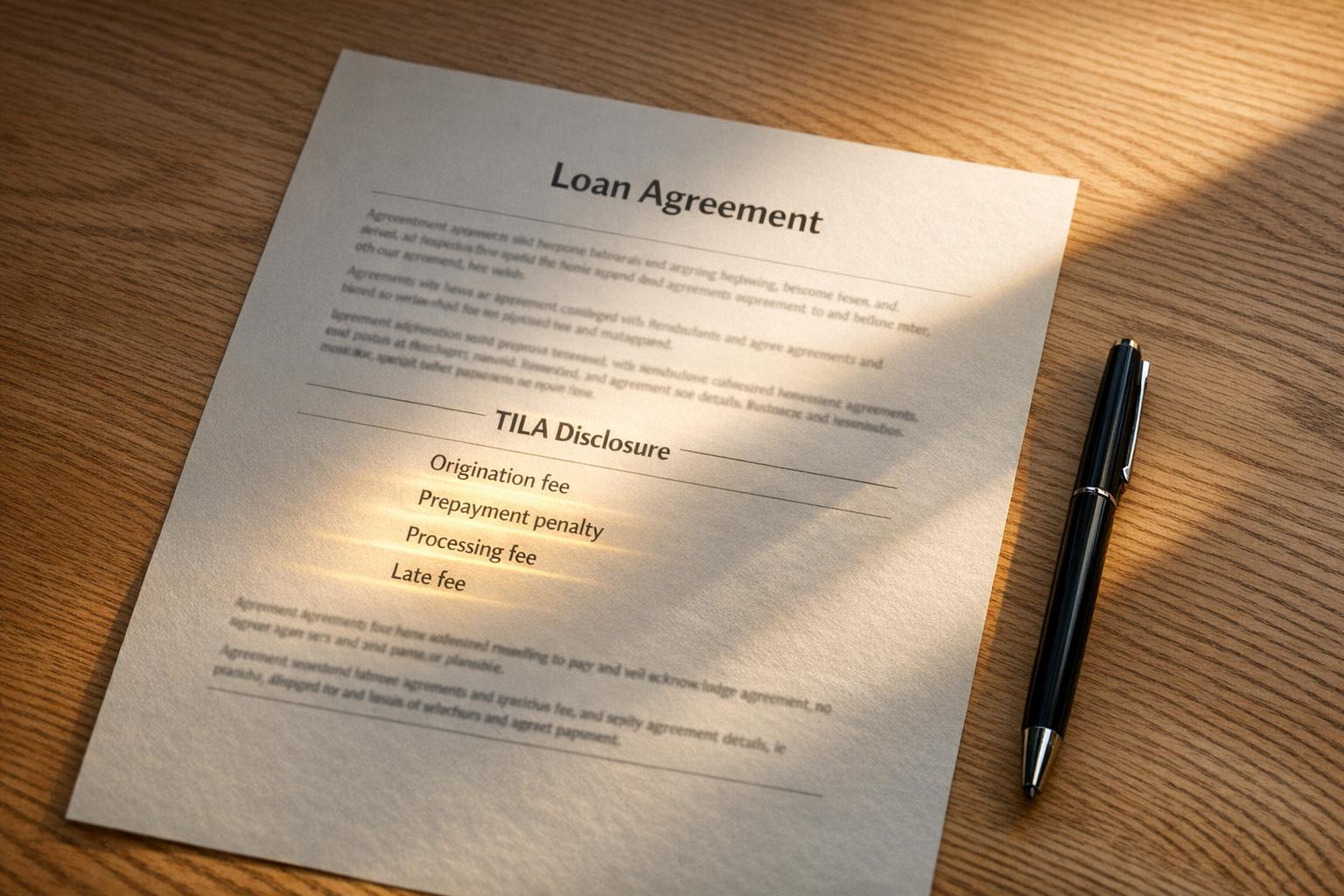
Hidden fees in loan agreements can quietly increase your borrowing costs by up to 10%, derailing your financial plans. Using a personal finance app can help you track these costs and stay on budget. These charges often hide in fine print or confusing terms, making them easy to miss. To protect your money, here’s what you need to know:
- Common Hidden Fees: Watch for origination fees (1%-10% of the loan amount), prepayment penalties (2%-5%), payment processing fees ($5-$15 or 1%-3% per transaction), late payment fees ($15-$50 or 3%-5%), and application fees ($25-$100).
- Key Documents to Review: Always request a detailed fee breakdown and review the Truth in Lending Act (TILA) disclosure for the APR, finance charges, and total payments.
- Red Flags: Be cautious of vague terms like "may charge" or "subject to" and optional add-ons like credit insurance that might be bundled without your consent.
- How to Avoid Fees: Compare APRs, negotiate fees (like application charges), and ask targeted questions about penalties or recurring costs.
Spotting these fees early can save you significant money over the life of your loan. Always review loan terms carefully and never hesitate to ask for clarification.

Common Hidden Loan Fees: Types, Costs, and How to Avoid Them
Common Hidden Fees in Loan Agreements
Understanding which fees to watch out for can help you avoid unnecessary expenses. Lenders often hide these charges in dense contract language, but once you know what to look for, they’re easier to identify. Here’s a breakdown of some common fees you might encounter.
Origination and Underwriting Fees
Origination fees cover the administrative work involved in processing your loan, while underwriting fees are tied to verifying your eligibility. These fees generally range from 1% to 10% of the loan amount, though some lenders may charge up to 12%. For federal student loans, Congress sets specific rates: 1.057% for direct subsidized and unsubsidized loans and 4.228% for PLUS loans as of October 2020.
Lenders may structure these fees in two ways: they could either deduct the fee from the loan amount you receive or add it to your total borrowed amount, which then accrues interest. Keep an eye out for terms like "administrative fee", "processing fee", or "underwriting fee" in your loan agreement.
Borrowers with credit scores in the mid-600s or higher often qualify for loans with lower or no origination fees. Some lenders, such as SoFi and Wells Fargo, don’t charge origination fees at all, while others, like Best Egg, have fees ranging from 0.99% to 9.99%.
| Lender | Origination Fee Range |
|---|---|
| Best Egg | 0.99% to 9.99% |
| Happy Money | 0.25% to 10% |
| Rocket Loans | Up to 9.99% |
| Upgrade | 1.85% to 9.99% |
| SoFi | None required |
| Wells Fargo | None |
(Source: NerdWallet, May 2025)
Since origination fees are upfront costs, they’re factored into your loan’s Annual Percentage Rate (APR). Comparing APRs instead of just interest rates gives you a clearer picture of your loan’s total cost.
Prepayment Penalties
Prepayment penalties are charges lenders impose if you pay off your loan earlier than scheduled. These fees compensate lenders for lost interest income. They can apply to various loans, including mortgages, auto loans, personal loans, and business loans, and often appear as terms like "early payoff fee", "exit fee", or "closing adjustment."
"Lenders make their money on monthly interest charges, so if you reduce the number of payments they receive, you're effectively cutting their profit. Prepayment penalties help the lender recoup some or all of the interest charges they'd otherwise lose if you pay your loan off early."
Prepayment penalties typically range from 2% to 5% of the original loan amount, though some lenders charge a flat fee or up to 12 months’ worth of interest. Look for these clauses under sections labeled "Fees", "Charges", or "Penalties" in your loan agreement. Federal law requires lenders to disclose prepayment penalties before you agree to the loan terms, so don’t hesitate to ask for clarification.
If your loan includes a prepayment penalty, calculate whether paying off your loan early will still save you money after accounting for the fee. Some credit unions and online lenders offer loans without prepayment penalties, which may be a better option.
Payment Processing and Maintenance Fees
Recurring fees like payment processing and maintenance charges can add up over time, increasing the overall cost of your loan.
Payment Processing Fees
These fees depend on how you make payments. For example:
- Paying by phone or paper check might cost $5 to $15 per transaction.
- Credit or debit card payments can incur fees of 1% to 3% of the transaction amount.
Switching to electronic ACH transfers, which are often free, can help you avoid these charges.
Maintenance Fees
Some loans, especially business lines of credit and certain personal loans, include ongoing maintenance fees. These charges, often labeled as "account maintenance" or "annual fees", may seem small but can accumulate over the life of your loan.
To identify these fees, scan your contract for terms like "administrative fee", "processing fee", "maintenance fee", or "service charge." Be cautious of vague language like "may charge" or "subject to", which can signal potential future fees.
Setting up automatic bank transfers (ACH) is one of the best ways to avoid processing fees, but remember to monitor your account to avoid overdraft issues.
Late Payment and Application Fees
Late payment fees can range from $15 to $50 or 3% to 5% of your monthly payment. If your bank account lacks sufficient funds, you could also face an NSF (non-sufficient funds) fee of $25 to $50, meaning a single missed payment could result in multiple charges.
Unless explicitly stated, don’t assume your loan includes a grace period. When offered, grace periods typically last 10 to 15 days. Review your agreement carefully to understand when late fees kick in.
Application Fees
These are one-time charges, usually between $25 and $100, for submitting your loan application. While less common today, if a lender insists on charging an application fee, consider requesting a waiver or exploring other lenders.
| Fee Type | Typical Cost/Range | How to Avoid |
|---|---|---|
| Late Payment Fee | $15–$50 or 3–5% | Set up autopay or use reminders |
| NSF/Returned Check | $25–$50 | Keep a buffer in your bank account |
| Application Fee | $25–$100 | Choose lenders with no application fee |
| Check Processing | $5–$15 per check | Use electronic ACH transfers |
| Card Processing | 1–3% of payment amount | Pay via direct bank transfer |
Setting up autopay is a simple way to avoid late fees and NSF charges, ensuring your payments are always on time. By carefully reviewing your loan terms, you can avoid unexpected fees and keep your finances on track.
sbb-itb-02fd20a
How to Review Loan Agreements
Once you're aware of the fees to look out for, the next step is to carefully examine your loan documents. Lenders are required by law to provide specific disclosures, and knowing how to review them can help you avoid unnecessary costs. Here's how to navigate your loan agreement effectively.
Request a Complete Fee Breakdown
Before signing anything, ask for a detailed breakdown of all fees in dollar amounts. Percentages can be misleading and make it harder to compare offers. For example, a 3% origination fee on a $100,000 loan equals $3,000.
Be specific in your request - ask for the exact dollar amount of every fee you’ll pay upfront, monthly, and over the loan term. This includes origination fees, application fees, payment processing charges, and penalties. If a lender hesitates or gives vague answers, consider that a warning sign.
Some fees, like application fees (often $25 to $50), can be negotiable and even waived if you ask. If a lender insists on excessive fees or lacks transparency, it may be time to explore other options.
Once you have this breakdown, cross-check the details with the disclosures required under the Truth in Lending Act (TILA).
Review the Truth in Lending Act (TILA) Disclosure
The TILA requires lenders to provide a disclosure form that outlines the true cost of your loan. This document is essential for identifying hidden fees, so make sure to request it before signing the final contract. Receiving an incomplete TILA disclosure is a violation of the law.
"The APR is the total cost of credit, including the interest rate and mandatory fees, expressed as a yearly rate in a percentage. It is not the same as the interest rate and can be significantly higher with added fees."
The TILA disclosure complements the fee breakdown by showing how mandatory fees impact your loan's overall cost. It includes four key details:
| TILA Disclosure Term | What It Reveals About Fees |
|---|---|
| APR | Combines interest and mandatory fees (e.g., origination or processing fees) |
| Finance Charge | The total dollar cost of the loan, including interest and fees |
| Amount Financed | The actual cash you receive after prepaid fees are deducted |
| Total of Payments | The total amount you’ll repay (Principal + Interest + Fees) |
Focus on the APR and Finance Charge. The APR shows the yearly cost of credit, making it the best figure for comparing offers. If the Finance Charge is much higher than the interest you expected, it could mean the loan includes high administrative or origination fees.
For mortgages, you’ll receive a Loan Estimate instead of a standard TILA disclosure. Pay attention to Section A (Origination Charges) and Section B (Services You Cannot Shop For), as these fees can vary between lenders. On page 3 of the Loan Estimate, you can calculate the cost of interest and fees over five years by subtracting the "principal you will have paid off" from the "total amount you will have paid".
Identify Misleading Fee Names
Once you have a clear fee breakdown and TILA disclosures, take a closer look at how fees are described. Lenders sometimes use vague or misleading language to make fees harder to spot. For example, prepayment penalties might be labeled as "early payoff charges", "exit fees", or "closing adjustments".
Here are some common examples of disguised fees:
- "Administrative fee", "processing fee", or "underwriting fee" – These often refer to origination fees.
- "Exit fees" or "early payoff charges" – These are typically prepayment penalties.
- "Service charges" or "account maintenance fees" – These may be recurring monthly fees.
- "Document preparation fees" – Charges for paperwork that might not even be necessary.
Be wary of vague terms like "may charge" or "subject to", which suggest potential future fees that aren’t clearly defined. Always ask for written clarification about what these fees entail and under what circumstances they apply.
Another tactic to watch for is the "no closing cost" loan. While these loans eliminate upfront fees, lenders often offset the cost through higher interest rates or larger monthly payments. This usually results in paying more over the life of the loan. Always calculate the total cost of the loan, not just the upfront expenses.
Verify Optional Add-Ons Are Not Required
Some lenders include optional products in loan agreements and present them as mandatory. A common example is credit insurance, which covers your loan if you die or become disabled. While it may sound helpful, these add-ons are often overpriced and almost always optional.
Check the "Amount Financed" section of your TILA disclosure carefully. This figure shows the cash you’ll receive after prepaid fees are deducted. If it’s lower than expected, optional products you didn’t agree to might have been added. Request an itemized breakdown to confirm.
Other optional add-ons to watch for include extended warranties, payment protection plans, and GAP insurance (for auto loans). If you didn’t explicitly request these, you can decline them.
If the TILA disclosure or Loan Estimate doesn’t match what your lender discussed verbally, consider it a major red flag. You’re under no obligation to proceed with a lender that lacks transparency. Ensuring that optional products remain optional helps you avoid unnecessary costs in your loan agreement.
Questions to Ask Your Lender
When reviewing your loan's fee breakdown and disclosures, it’s essential to ask the right questions to uncover any hidden costs. Lenders may not always volunteer details about fees that can be waived or negotiated. By asking targeted questions, you can identify less obvious charges and potentially secure better terms.
What Are All the Fees?
Start by asking: "Can you provide a detailed breakdown of every fee, both upfront and recurring?" This question pushes the lender to disclose all costs, not just those included in the APR calculation.
"When weighing your options, ask potential lenders for a full schedule of fees and the exact amounts of each charge."
- PenFed
Pay close attention to their response. If they only mention origination fees and interest, ask about other charges like application fees (usually $25–$50), late payment fees (often $25–$50 or 3%–5% of your payment), NSF fees (around $32), and processing or documentation fees.
If an application fee is included, request that it be waived. As PenFed advises:
"If a potential lender wants you to pay an application fee, you should ask for it to be waived - or search for another loan partner".
Additionally, make sure to ask about penalties for early repayments.
Are There Prepayment or Early Termination Penalties?
Ask: "Are there any penalties for paying off the loan early or making extra payments, and how are they calculated?"
Prepayment penalties for personal loans typically range from 2% to 5% of the original loan amount. For mortgages, these fees are often calculated as 1%–2% of the remaining balance or as a set number of months of interest (e.g., six to twelve months). Government-backed loans like FHA, VA, and USDA mortgages, as well as federal student loans, do not allow prepayment penalties, but conventional mortgages and auto loans under 60 months often include them.
If your loan includes prepayment penalties, ask how they are calculated and whether they apply to the full balance or just amounts above a certain threshold. Some lenders allow up to 20% of the loan balance to be repaid annually without penalty. Also, inquire about early termination fees if you’re considering a line of credit, as these fees might be listed separately. Check your TILA disclosure for the specifics.
Which Add-Ons Are Optional and Do Payment Methods Cost Extra?
Ask: "What optional services or add-ons are included, and can I decline them without affecting my loan terms? Do certain payment methods incur extra charges?"
Optional add-ons often include credit insurance, disability insurance, and non-filing insurance. While these products are typically not mandatory, some lenders may bundle them into your loan without clear disclosure. Request a breakdown that separates mandatory charges from optional ones, and confirm in writing that declining these add-ons won’t impact your loan approval or interest rate.
Also, clarify whether the quoted interest rate depends on enrolling in autopay. Some lenders require automatic payments to qualify for their lowest rates. Be aware that paying by credit or debit card may come with processing fees of 1%–3% of the payment amount, while bank transfers (ACH) are usually free. If you prefer paying by check or phone, ask if there are any convenience fees. Declining unnecessary fees can help you stay in control of your loan costs.
By asking these questions and obtaining a full breakdown of fees, you'll be better equipped to negotiate favorable terms. Tools like Monefy can also help you track expenses and manage your budget, ensuring hidden fees don’t derail your financial plans.
Questions? Answers.
What is the difference between APR and interest rate?
The interest rate is the cost of borrowing the principal amount, expressed as a percentage. The APR (Annual Percentage Rate) includes the interest rate plus mandatory fees like origination fees and prepaid costs. APR gives a more complete view of the loan's total cost and is the best figure to use when comparing offers.
Can I negotiate loan fees with my lender?
Yes, many loan fees are negotiable. Application fees can often be waived, and origination fees might be reduced if you have strong credit or agree to a slightly higher interest rate. Prepayment penalties can sometimes be removed before signing. Always ask about flexible fees and get any changes in writing.
Are prepayment penalties legal on all types of loans?
No, prepayment penalties are prohibited on certain loans like federal student loans and government-backed mortgages (FHA, VA, USDA). Auto loans with terms longer than 60 months are also barred from including these penalties. However, conventional mortgages, shorter-term auto loans, and many personal loans may still include them depending on state laws and lender policies.
What should I do if my lender won't provide a complete fee breakdown?
If a lender refuses to give a detailed, written breakdown of fees or provides vague answers, consider it a major red flag. Lenders are legally required to provide TILA disclosures that outline the true cost of credit. If they’re not transparent, it’s best to find a lender who will clearly itemize every charge.
Is credit insurance required when taking out a loan?
No, credit insurance is almost always optional. It covers loan payments in cases like death or disability but is often overpriced. Some lenders may present it as mandatory or include it without clear disclosure. Always verify if insurance products are optional and ask for them to be removed if you don’t want them.
How to Compare Loan Offers
After collecting fee breakdowns and asking key questions, the next step is to compare your loan offers side by side. Many borrowers fall into the trap of focusing only on the advertised interest rate. Unfortunately, this can lead to surprises down the road when hidden fees make what seemed like a cheaper loan the most expensive option. Shopping around can save you anywhere from $600 to $1,200 annually on a mortgage. Plus, interest rates for a 30-year fixed-rate conventional loan can differ by more than 0.5% between lenders. By carefully evaluating your options, you’ll be better equipped to choose the most cost-effective loan. Here's how to do it.
Compare APR, Not Just Interest Rates
The Annual Percentage Rate (APR) is your best tool for comparing loans because it reflects both the interest rate and most lender fees, such as origination charges and points. For instance, while a loan with a 9.5% interest rate might seem cheaper than one at 10.2%, higher fees can make the lower rate costlier overall. Always ask for the APR from every lender and use it as your primary comparison metric.
| Feature | Interest Rate | Annual Percentage Rate (APR) |
|---|---|---|
| Includes Principal Interest | Yes | Yes |
| Includes Origination Fees | No | Yes |
| Includes Points/Credits | No | Yes |
| Best for Comparing Total Cost | No | Yes |
Get Loan Estimates in the Same Format
For mortgages, federal law requires lenders to provide a standardized three-page Loan Estimate within three business days of your application. This document is designed to make comparisons easier by presenting key details like interest rates, monthly payments, and closing costs in the same format. Pay close attention to sections like origination charges (Section A), services you can shop for (Section C), and lender credits (Section J).
To ensure accurate comparisons, request Loan Estimates from all lenders on the same day - this avoids discrepancies caused by market fluctuations. Additionally, ask for identical loan terms, including the same loan amount, term length, and product type. This ensures you're comparing offers on equal footing.
"Standardization makes the information easy to digest and compare offers among lenders to see which one is the best deal."
Loan Estimates are usually valid for just 10 business days, so don’t take too long to make your decision. If you're applying for personal or auto loans, ask each lender for a written breakdown in a consistent format, even if they aren’t legally required to use a standardized form.
Calculate the Total Cost of Each Loan
While the APR is a great starting point, it doesn’t show the exact dollar amount you’ll pay over the life of the loan. To get the full picture, calculate the total cost by adding the principal, total interest, and all fees - including upfront charges like origination fees and recurring costs like late payment penalties.
For mortgages, check page 3 of the Loan Estimate for the "In 5 years" total. This figure combines the principal, interest, and fees paid over the first 60 months. Subtract the principal paid during this period to see the true cost of borrowing. This calculation is especially helpful since many borrowers either move or refinance within five years.
For personal loans, add up the principal, interest, and fees to determine the total repayment. For example, a $10,000 loan with a 12.64% APR over three years might have monthly payments of $335 and cost $2,067 in interest. In contrast, the same loan at a 35.99% APR could rack up $6,487 in interest - more than triple the cost. Once you’ve calculated the total cost for each loan, the one with the lowest overall cost is your best choice, regardless of flashy interest rate ads.
If you’re juggling multiple loan payments or want to track fees, apps like Monefy can help you stay organized and on budget. By carefully comparing offers and calculating total costs, you can sidestep hidden fees and pick a loan that genuinely saves you money.
Conclusion
Taking a final look at your loan's fee structure can save you from unexpected costs. Hidden fees can increase a loan's total cost by as much as 10%. To avoid surprises, ask detailed questions, carefully review all documents, and never sign anything you don’t fully understand.
Make sure to request the Truth in Lending Act (TILA) disclosure and an itemized fee schedule from each lender. As mentioned earlier, focus on the APR, not just the interest rate, since the APR includes mandatory fees like origination charges. Pay close attention to penalty clauses - such as prepayment penalties, late fees, or payment processing charges - and ensure optional add-ons like credit insurance aren’t automatically included. These steps help you make informed decisions and avoid unnecessary costs.
"The best loan isn't just the one with the lowest rate. It's the one you fully understand." - JG Wentworth
Borrowers who compare at least three loan offers typically save an average of $3,000 over the life of their loan. Be cautious of lenders who use vague terms like "additional fees may apply" or refuse to provide a clear fee breakdown - these are red flags for a lack of transparency. In such cases, it’s better to walk away.
Once you’ve secured a loan, tools like Monefy can help you track payments and avoid costly late fees. Remember, loan agreements are legally binding and can affect your finances for years. By sticking to these strategies, you’ll secure a loan that aligns with your budget and long-term financial goals instead of one that burdens you with hidden charges.