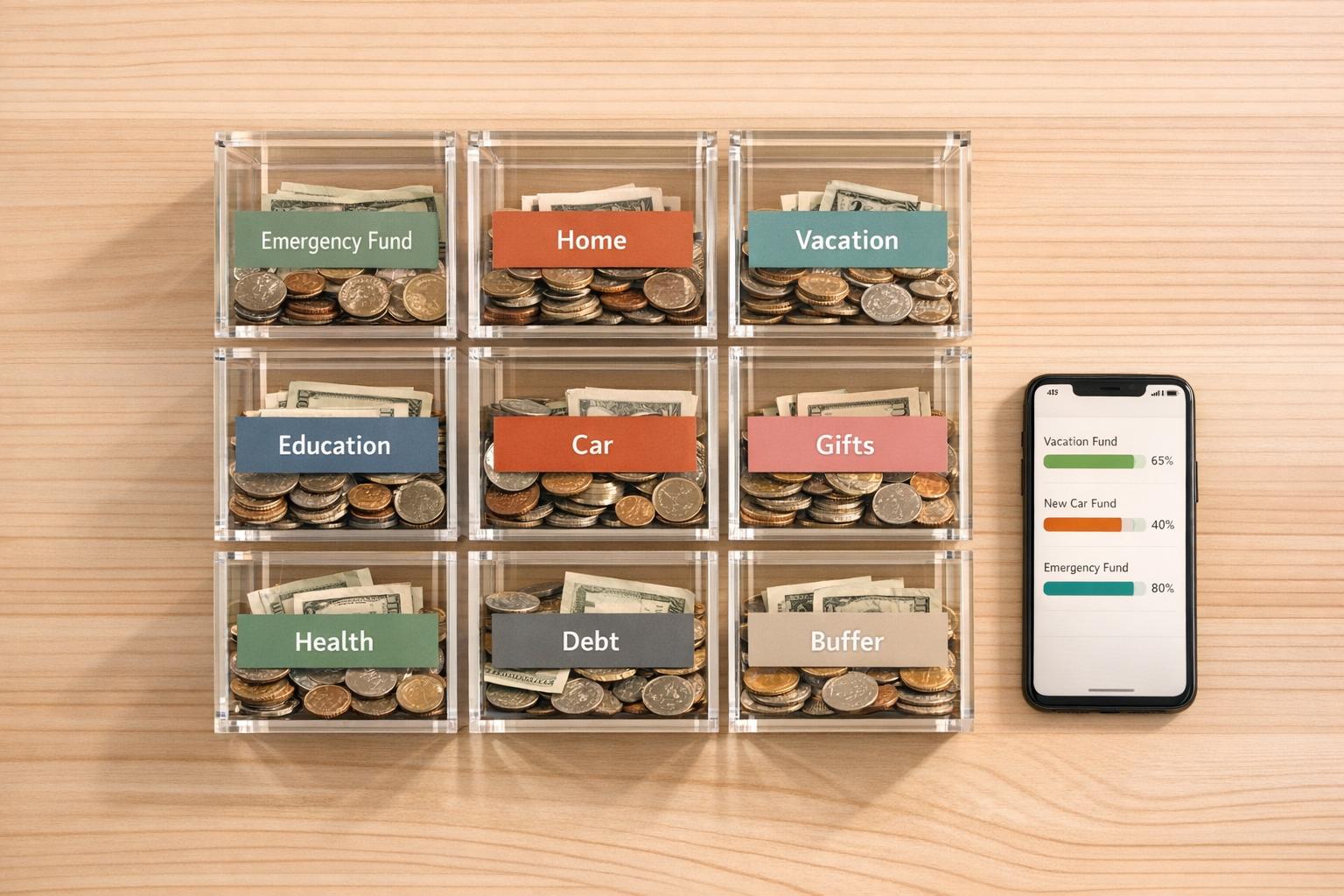
Saving for multiple goals doesn’t have to be confusing or overwhelming. Whether it’s an emergency fund, a vacation, or retirement, you can stay organized by breaking goals into clear categories, using tools like separate accounts or digital buckets, and tracking your progress consistently. Here’s a quick breakdown:
- Define Goals Clearly: Write down your goals with specific amounts, deadlines, and priorities.
- Organize Savings: Use separate accounts or virtual buckets to keep funds distinct and avoid accidental spending.
- Track Progress: Use spreadsheets or apps to monitor savings and stay motivated.
- Adjust Regularly: Review your plan monthly or quarterly and reallocate funds as needed.
- Celebrate Milestones: Reward yourself for hitting targets to maintain motivation.

5-Step Process to Track Multiple Savings Goals Effectively
Step 1: Define Your Savings Goals
Knowing exactly what you're saving for - and why - is the first step to building a solid financial plan. Vague goals like "saving for the future" aren't helpful. What you need instead are specific targets: clear dollar amounts, deadlines, and a ranking of which goals matter most. Laying this groundwork now will make it easier to track your progress later.
Start by writing down all your savings goals. These might include essentials like an emergency fund or paying off high-interest debt, lifestyle upgrades like a vacation or new car, and long-term dreams such as starting a business or retiring early. Be thorough - getting everything on paper is key.
Categorize Your Goals
Once you’ve listed your goals, group them by time horizon. This step helps you decide how much to save and where to stash the money. Short-term goals, for instance, need to stay in safe, accessible accounts, while long-term goals can handle more risk for potentially higher returns.
| Category | Timeline | Examples | Where to Keep It |
|---|---|---|---|
| Short-term | Less than 2 years | Vacation, wedding, emergency fund | Cash, CDs, money market accounts |
| Medium-term | 2–10 years | Home down payment, new car | A mix of bonds and stocks |
| Long-term | 10+ years | Retirement, college tuition | Stocks, IRAs, 401(k)s |
You can also organize goals by urgency and necessity. For example, building an emergency fund to cover three to six months of living expenses should usually take priority. Once that safety net is in place, you can shift focus to quality-of-life goals (like a vacation) or bigger aspirations (like early retirement).
With your goals categorized, the next step is to attach specific numbers and deadlines.
Set Target Amounts and Deadlines
Each goal needs a clear dollar target and a deadline. Once you have those, you can calculate how much to save each month to stay on track.
For instance, say you want to save $3,000 for an emergency fund in 18 months. Divide $3,000 by 18, and you’ll need to save about $166.67 per month - or roughly $41.67 per week. Breaking it down like this makes the goal feel more manageable and keeps you motivated.
Use the SMART framework to ensure your goals are well-defined. Each goal should be:
- Specific: Clear and detailed
- Measurable: Easy to track progress
- Attainable: Realistic for your budget
- Relevant: Aligned with your priorities
- Time-bound: Tied to a deadline
If your monthly savings goal feels too high, adjust the amount or extend the timeline.
"Socking away a few extra dollars in a savings account each month may not be the best way to save for multiple financial goals." – Chris Kawashima, Senior Financial Planner, Charles Schwab
One couple, for example, set three goals: $30,000 for a home in 3 years, $60,000 for college in 6 years, and $900,000 for retirement in 25 years. By saving for all three at once, they calculated a lifetime savings need of $481,200 - over $100,000 less than if they had tackled each goal separately. The difference came from leveraging compound interest.
After calculating your monthly savings needs, it’s time to prioritize.
Prioritize Your Goals
You can’t fund everything at once, so prioritizing your goals is essential. This prevents "savings paralysis" and ensures you focus on what matters most.
Financial planners often suggest narrowing your active goals to a "top three": one short-term goal, one medium-term goal, and one long-term goal. This keeps your plan manageable while letting you make progress across different timeframes.
When ranking goals, ask yourself: What happens if I don’t reach this goal? If the consequences include high-interest debt, financial instability, or poverty in retirement, that goal should rise to the top. For most people, emergency funds and paying off high-interest debt should take precedence over discretionary goals like vacations.
"Save for the categories with the most severe consequences first - and retirement tops that list, since no one wants to be impoverished in old age." – Noah Damsky, Principal, Marina Wealth Advisors
A common budgeting rule, the 50/30/20 rule, can help you allocate your income:
- 50% for needs
- 30% for wants
- 20% for savings and debt repayment
For retirement specifically, aim to save at least 15% of your pre-tax income.
Once you’ve ranked your priorities, divide your monthly savings accordingly. For example, if you have $450 to save each month, you might allocate:
- 40% ($180) to an emergency fund
- 33% ($150) to a medium-term goal like an education fund
- 27% ($120) to a short-term goal like a vacation
This way, you’re working toward all your goals without neglecting the most important ones.
Step 2: Organize Your Savings with Separate Accounts or Buckets
Once your goals are crystal clear, the next step is to separate your savings so each target stays distinct. Keeping all your savings in one account might seem convenient, but it can blur your progress and make it easier to spend money meant for emergencies or long-term plans. By dividing your funds, you create a mental barrier that helps protect your goals from impulsive spending.
You have two main choices: open multiple savings accounts at your bank or use a single account with virtual buckets (also called sub-accounts or vaults). Virtual buckets are especially handy because they let you manage everything under one login while keeping your savings clearly allocated. Plus, you can earn interest on the total balance instead of splitting it across multiple accounts.
"Make a 'European 2024 vacation' account, so there's an attachment to it... you'd have to consciously go rob from your European vacation account, and it's a huge barrier for people to do that." – Brad Klontz, Financial Psychology Professor, Creighton University
How to Set Up Multiple Accounts
If you prefer the multiple accounts approach, your bank can help you open additional savings accounts, often through a quick online process. Each account will have its own number and statement, making it easy to track progress for every goal. However, this method has some downsides, like managing multiple logins, risking dormant account fees, and potentially missing out on compound interest if balances are too low.
Alternatively, virtual buckets offer a modern, streamlined option. Banks like Ally Bank allow up to 30 buckets within a single account, while SoFi supports up to 20 "Vaults", and Capital One offers up to 25 separate accounts that act like buckets. To set this up, log into your bank’s app, find the savings account section, and look for options like "Buckets" or "Manage Buckets." You can create and label categories in just a few clicks.
Once your buckets are set up, automate your contributions. Schedule transfers from your checking account to each bucket on payday - maybe $180 for emergencies, $150 for education, and $120 for a vacation. Some banks even offer tools like round-ups to help you save more effortlessly.
Tips for Naming and Visualizing Your Goals
When naming your buckets, skip generic labels and go for something specific and motivating. For instance, "2026 Japan Trip" feels more exciting and personal than "Travel Fund", and "New Kitchen Appliances" is clearer than "Home Stuff." A vivid name makes it harder to justify spending the money on unrelated things.
"Mediterranean cruise makes for a better visual than Vacation." – Ally Bank
Along with names, set a target amount and deadline for each bucket. This keeps your savings plan structured and aligned with the goals you outlined earlier.
Most banking apps also include visual tools like progress bars, percentage trackers, and countdowns to help you monitor your savings. Watching a progress bar inch closer to 100% can be incredibly motivating. Some apps even let you "lock" buckets, such as your emergency fund, to prevent accidental spending.
To avoid feeling overwhelmed, limit the number of active buckets. While some banks allow dozens of buckets, financial experts suggest focusing on your top three goals at a time - one short-term, one medium-term, and one long-term. This keeps things manageable and ensures steady progress.
Once your savings are organized, you’ll be ready to track your progress effectively.
Step 3: Choose a Savings Tracking Method
Now that you've set up separate accounts or buckets for your savings goals, the next move is to track your progress in a way that keeps you motivated and on course. The right tracking method not only helps you stay accountable but also highlights your achievements and flags when adjustments are needed. You have two main options here: creating a custom spreadsheet or using a savings app.
Track Goals with Spreadsheets
Spreadsheets are perfect if you want full control over your data, value privacy, and prefer to avoid subscription fees. Start by listing each savings goal with columns for Target, Saved, Remaining (Target – Saved), and Progress (%). To make things visually engaging, use tools like SPARKLINE in Google Sheets to create progress bars. Excel users can achieve a similar effect with Data Bars via conditional formatting.
Organize your deposits by adding a "Contributions" tab. Log each deposit with details like the date, goal name, and amount. Then, use formulas like SUMIF to automatically calculate the total contributions for each goal. To minimize errors, you can set up dropdown menus with Data Validation for consistent input.
Visualizing your progress is a game-changer. Turning numbers into easy-to-read visuals makes your savings journey feel more tangible. As FinancialAha puts it:
"Visualization transforms saving from an invisible sacrifice into visible progress, which makes a real difference in staying motivated over months or years."
Experts recommend focusing on no more than 3–5 active goals at a time to avoid feeling overwhelmed.
If spreadsheets feel like too much work, though, a savings app might be a better fit.
Use a Savings App Like Monefy

If you want a simpler, more automated option, Monefy is a great choice. This app allows you to create specific categories for each savings target - like an Emergency Fund, Vacation, or New Car - keeping your goals separate from your regular spending. Manual entry for transactions is quick, usually taking less than 10 seconds per entry, so you stay actively involved in managing your money.
Monefy’s interface makes tracking progress easy with charts and milestones. You can even break larger goals into smaller steps to celebrate achievements along the way. The app supports multi-account management, so you can track everything from checking accounts to high-yield savings and CDs, all in one place. Its transfer feature ensures no double-counting when moving money between accounts. Plus, for couples working toward shared goals, cloud sync via Google Drive or Dropbox ensures both partners can stay updated in real time.
It’s worth noting that many people underestimate their spending by 20–30% when relying on memory alone. By logging every deposit and withdrawal, Monefy provides a clear picture of where your money is going. You can even export your data to CSV or Excel for a deeper analysis.
Whether you prefer the hands-on approach of spreadsheets or the convenience of an app, tracking your savings is the key to staying motivated and hitting your financial goals.
sbb-itb-02fd20a
Step 4: Monitor Progress and Adjust as Needed
Every dollar you save should move you closer to your goals, but life happens - unexpected expenses or changes can throw things off. That's why regularly reviewing your progress and tweaking your savings plan is so important.
Schedule Regular Check-Ins
How often you check in depends on what keeps you motivated. Monthly reviews are great for spotting small issues, like overspending in certain categories, while quarterly check-ins give you a bigger picture of how you're doing and allow for strategic adjustments to investment goals . Major life events - like a new job, marriage, or even having a child - are good reasons to reassess your financial priorities and make necessary updates. As you approach key deadlines, consider moving funds into more stable options, like cash or short-term bonds, to protect your progress.
| Review Frequency | Focus Area | Best For |
|---|---|---|
| Weekly | Discretionary spending & category caps | Quick adjustments |
| Monthly | Savings balance vs. target | Catching small leaks early |
| Quarterly | Investment growth & asset allocation | Long-term planning |
After each review, adjust your allocations to reflect any changes in your priorities or financial situation.
Reallocate Funds Based on Priorities
Regular reviews can highlight areas where adjustments are needed. For example, if you're falling behind on a critical goal like building an emergency fund, consider temporarily redirecting money from less urgent categories, like a vacation fund or a gadget budget, until you're back on track. Flexibility is key - sticking rigidly to goals without accounting for life's unpredictability can set you up for failure.
"When your goals are too extreme and you're going in with an 'all or nothing' mindset, you essentially set yourself up to fail because you don't account for all the 'gray' areas of life that may pop up."
If a goal starts to feel out of reach, extend its timeline and use unexpected income, like tax refunds or bonuses, to close the gap. For context, in 2024, the average personal savings rate in the U.S. was about 4.4%. That means for every $100 earned, people saved just $4.40. Even small windfalls can make a noticeable difference when directed toward lagging goals.
If you're using tools like Monefy, take advantage of features like notes to track why you moved funds. For instance, jotting down "Tax refund allocation" or "Car repair withdrawal" can help you see which strategies are working and keep you accountable . You can also export your data to CSV or Excel for a more detailed analysis of spending patterns and long-term trends that might not be obvious in the app .
Step 5: Stay Motivated and Celebrate Milestones
Saving for multiple goals at the same time can feel like a marathon. Without regular motivation, it’s easy to lose focus. The key is to make your progress visible and reward yourself along the way - not just when you hit the final target.
Visualize Your Progress
Seeing your progress in action can be a game-changer. A number in your savings account might feel abstract, but watching a progress bar inch from 25% to 26%? That’s something you can actually celebrate. Visualization makes your achievements feel more real and keeps you motivated over time.
"A number in a savings account is abstract. A progress bar filling from 25% to 26%? That's tangible motivation." – FinancialAha
If you’re into spreadsheets, tools like SPARKLINE formulas in Google Sheets or color-coded conditional formatting can make your progress stand out. Want something a little more inspiring? Create a vision board - either on Pinterest or a physical one - filled with images of your goals, like that dream vacation or your future home.
Breaking down larger goals into smaller milestones also helps. For example, if you’re aiming for a $10,000 emergency fund, celebrate when you hit 25%, 50%, and 75% of your goal. Some people even track “contribution streaks,” focusing on how many months in a row they’ve saved rather than just the dollar amount.
If you’re using apps like Monefy, take advantage of their built-in charts and graphs to track your progress. Even during slower months, seeing that upward trend can remind you that you’re still moving forward.
Turning your savings into something you can see and measure makes every step feel like an accomplishment.
Reward Yourself for Milestones
Once you’ve made your progress visible, it’s time to celebrate those wins. Recognizing your milestones not only feels good but also strengthens your saving habits. Build small rewards into your plan to keep your momentum going.
These celebrations don’t have to break the bank. Treat yourself to a favorite takeout meal, plan a cozy movie night at home, or enjoy a weekend hike with friends. Even non-monetary rewards - like spending extra time on a hobby or updating your tracker - can feel incredibly satisfying.
You might decide to celebrate every 25% of progress or every $250 saved, depending on your goals. If you’re saving as a family, get the kids involved in the celebration. It’s a great way to teach them about patience and the value of saving. And if your goal is to pay off debt, stick to rewards that don’t involve spending much - or any - money.
Aligning your rewards with your goals keeps the process fun and ensures you stay motivated for the long haul.
Conclusion
Managing and tracking multiple savings goals might seem like a challenge, but with the right approach, it becomes much easier. By automating your transfers and regularly checking your progress, you can make steady progress - even with small contributions.
The key to success lies in automation and consistent reviews. Schedule automatic transfers right after payday to prioritize saving, and plan monthly or quarterly check-ins to evaluate your progress. This way, your savings can grow effortlessly, even when life gets hectic.
Saving for several goals at once isn't about overextending yourself - it's about using your money wisely. Starting small can make a big difference. For instance, setting aside just $50 a month can accumulate over time, and you can always increase this amount when your budget allows. Whether you prefer spreadsheets or apps like Monefy, the most important thing is staying consistent. Begin today and stick with it!
FAQs
How many savings goals should I track at once?
One way to stay on top of your savings goals is by using separate accounts or savings buckets. The exact number you need will depend on what you're saving for and how you prefer to manage your money. However, juggling too many accounts can quickly become more of a hassle than a help.
For most people, having 2 to 5 accounts or buckets strikes a good balance. This setup keeps your goals clear and makes it easier to stay accountable without feeling overwhelmed.
Should I use separate accounts or savings buckets?
Using several savings accounts can be a great way to keep your financial goals organized and clear. If opening multiple accounts feels overwhelming, you can opt for savings buckets within a single account. These buckets let you allocate funds toward different goals while keeping everything in one place. The right choice depends on your personal financial style and what works best for your routine.
How do I decide how much to put toward each goal each month?
To manage your monthly savings effectively, begin by defining what you're saving for - whether it's an emergency fund, a dream vacation, or a down payment on a home. Be specific about your goals and set deadlines that feel achievable. Once your goals are clear, rank them based on urgency and importance.
Next, decide how much of your income to allocate toward each priority. This could be a fixed dollar amount or a percentage, depending on your budget. Start with the most pressing goal and work your way down. To stay on track, consider using budgeting apps or similar tools to monitor your progress. These can help you make adjustments if your financial situation shifts or your priorities evolve.