
Yes - domain investing can still make money in 2026, but for most people it’s a slow, risky bet that loses to safer options unless the numbers are tight. If your money can earn about 4.3% to 4.7% a year in U.S. Treasury bills, a domain portfolio has to beat that after renewals, commissions, and years of holding.
Here’s the short version:
- Many domains never sell
- Sale price is not profit
- Renewal fees can wreck returns
- .com names tend to hold up better than high-renewal extensions
- AI, geo, and brandable names can work - but only in narrow cases
- Tracking every cost is the only way to know if you’re ahead
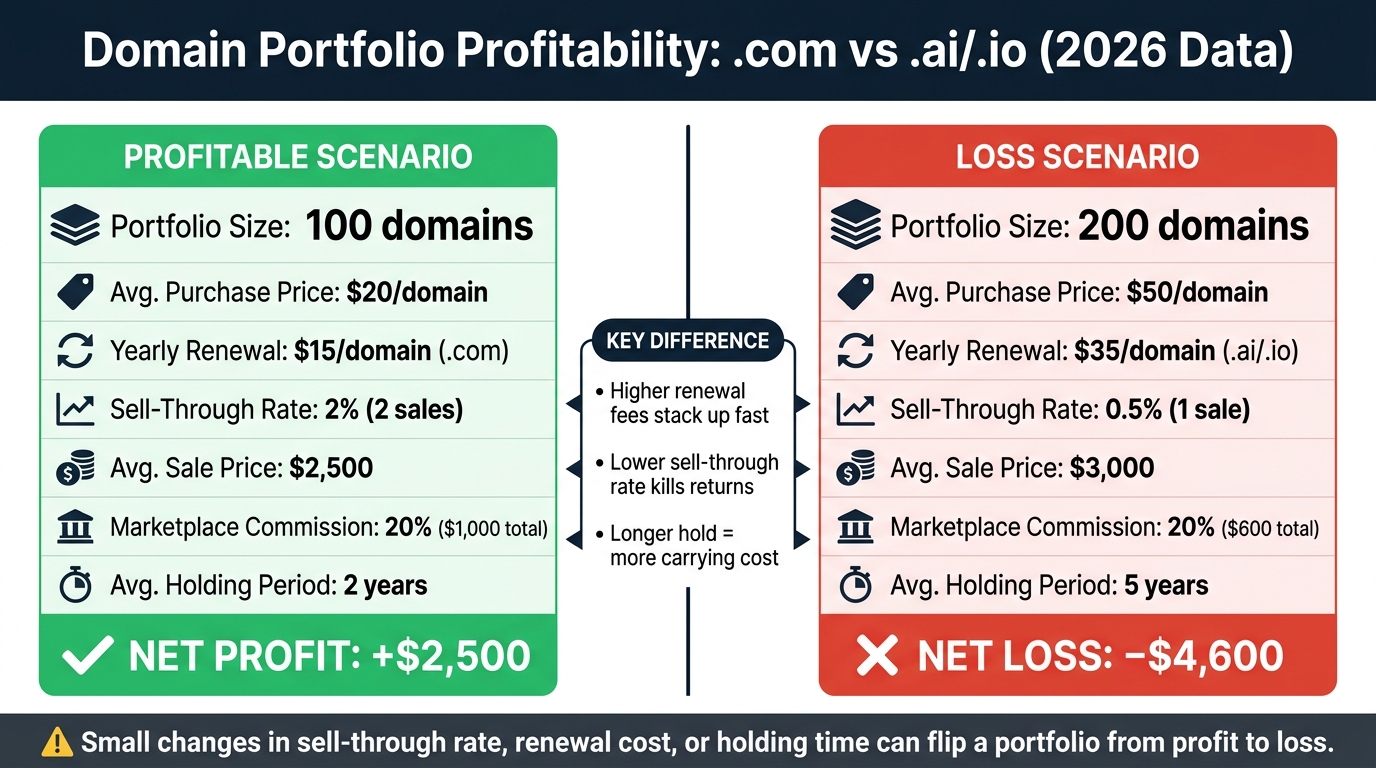
One example from the article says a 100-name .com portfolio bought at $20 per name with $15 yearly renewals, a 2% sell-through rate, and $2,500 average sales could end up around +$2,500 over a 2-year hold. But a 200-name .ai/.io portfolio bought at $50 per name with $35 renewals, a 0.5% sell-through rate, and $3,000 average sales could still land at about -$4,600 over 5 years.
That’s the whole point: small changes in sell-through rate, renewal cost, or holding time can flip a portfolio from profit to loss.
| Category | General 2026 Outlook | Main Risk |
|---|---|---|
| .com business names | Best shot at profit | Overpaying and long hold times |
| AI-related domains | Works if tied to actual products or services | Hype buys that never get end users |
| Geo domains | Can sell to local businesses | Small buyer pool |
| Brandable startup names | Can sell at good prices | High subjectivity and slow turnover |
If I were sizing this up, I’d treat domain investing as a small side bet, not a core asset. I’d stick to names with clear buyer use, avoid trademark risk, and track registrations, renewals, auctions, commissions, and sale proceeds in one place so I could see net return instead of guessing from big headline sales.
That’s the lens this article uses: not “Can domains sell?” but “Can they still beat costs, time, and safer returns in 2026?”
Market Reality: What 2026 Data Actually Shows
Reported Sales vs. What Most Investors Actually Earn
Public sales highlight the wins. They don't show the usual outcome.
What matters is net return, not the sale price by itself. A domain might sell for a decent number and still lose money if the proceeds don't beat the purchase price, renewal costs, and marketplace fees before the holding period ends.
That changes the lens. Instead of looking at gross sales and thinking, "That domain sold, so the deal worked", the better question is: Did the owner come out ahead after all costs?
Where Buyer Demand Is Concentrated in 2026
Buyer demand isn't spread evenly across domain categories. Some areas get more attention than others, while plenty of names sit for a long time with little or no interest.
That's why cost tracking matters more than hype around any one category. If you want a clear picture, track every:
- purchase
- renewal
- sale
Once you do that, you can see the actual profit or loss instead of guessing from headline sales.
Next, break down the full cost of holding a domain.
sbb-itb-02fd20a
Profitability Math: Costs, Fees, and Realistic ROI
Domain Investing Profitability 2026: .com vs .ai/.io Portfolio Math
The Full Cost Behind Every Domain
The next question isn't whether domains can sell. It's whether the math still works once you factor in fees and time.
A domain's actual cost goes past the buy price. You also need to count annual renewals and the commission taken when the name sells.
How Small Changes in Assumptions Flip Profit to Loss
Tiny shifts in sell-through rate, renewal costs, or sale price can wipe out profit fast. That's the part many people miss. On paper, domain investing can look strong. In practice, it often works only when a few numbers line up just right.
| Portfolio Size | Avg. Purchase Price | Yearly Renewal | Sell-Through Rate | Avg. Sale Price | Marketplace Commission | Avg. Holding Period | Est. Net Profit/Loss Over Holding Period |
|---|---|---|---|---|---|---|---|
| 100 domains | $20 | $15 (.com) | 2% (2 sales) | $2,500 | 20% ($1,000 total) | 2 years | +$2,500 |
| 200 domains | $50 | $35 (.ai/.io) | 0.5% (1 sale) | $3,000 | 20% ($600 total) | 5 years | −$4,600 |
That comparison tells the story pretty clearly. A .com portfolio with lower renewals and a slightly better sell-through rate can stay in the black. But a .ai or .io portfolio can slide into the red, even with a higher average sale price, because the carrying costs keep stacking up.
Higher renewal fees for .ai and .io portfolios, paired with even a small dip in sell-through rate, can wipe out the upside from that higher ticket price.
Those costs don't land the same way in every part of the market, which is why the next section looks at where profit still shows up.
Liquidity, Holding Time, and Opportunity Cost
Money tied up in unsold domains isn't just sitting still. It's also picking up renewal fees year after year instead of earning returns somewhere else. Each extra year a domain stays unsold adds another renewal bill to the total cost.
If you don't track purchase price, renewals, commissions, and holding time, the return can look a lot better than it is.
Category Breakdown: Where Investors Profit and Where They Don't
The math is only half the story. Category choice often decides whether those numbers can work at all.
Some domain types carry more risk than others. And profit usually comes down to one simple thing: can a clear end user pay enough to cover the purchase price, renewals, and fees?
.Com Business Domains and AI-Related Names
Domains with an obvious business use are usually easier to justify. The buyer can see right away how the name fits a product, service, or company.
That kind of clarity helps. But it doesn't promise a profit.
If you pay too much up front, or the name sits for years without a sale, renewal costs can eat away at the upside. A good name bought at the wrong price can still turn into a bad deal.
AI names follow the same pattern. Names tied to an actual tool, platform, or service are easier to defend than names that just ride AI buzz. There's a big difference between use case and hype.
When a purchase leans on hype instead of end-user demand, it is more likely to become a renewal bill than a profit.
Geo Domains and Brandable Startup Names
Geo domains can work when a local business has a clear reason to buy. The catch is that the buyer pool is small. In plain English, that often means slower sales.
And when sales move slowly, each extra year adds to carrying cost.
Brandable startup names are even more subjective. A name might sound memorable to one founder and do nothing for another. Timing matters too. The right buyer may show up fast, or not at all.
These names can sell well, but they often call for longer holding periods and tighter buying standards.
So domain investing isn't one big yes-or-no bet. It's a category-by-category call.
Decision Framework: Does Domain Investing Fit Your Financial Plan?
Given the fee drag and slow liquidity above, the next step is simple: decide whether this kind of risk even belongs in your plan.
Domain investing is a speculative bet, not a core part of a financial plan. Treat domains as a small, capped allocation. And the higher the renewal cost and the longer the expected holding period, the smaller that slice should be.
If that allocation still fits your budget, use this quick screen before each purchase.
A Simple Risk Check Before You Buy
Run these four filters before spending anything:
- Can you lock this money up for several years? Domains are illiquid by nature.
- Does the name carry trademark risk? If a brand could send a cease-and-desist, walk away.
- Does it fit one category you've researched? Buying across too many categories without a clear edge adds renewal costs.
- Can you absorb the worst case? Stress-test three outcomes: strong sale, break-even, or never sells. If the worst case blows up your budget, the purchase is too large.
Using Monefy to Track Domain Spending and Results

Once you buy, tracking matters more than enthusiasm. Without clean records, it's almost impossible to tell whether the side hustle is profitable or just an expensive hobby.
Monefy's manual entry approach helps here because it pushes you to notice every fee. Set up separate categories for each type of cash flow so you can see what's happening at a glance:
| Monefy Category | Cash-Flow Effect | Financial Decision Supported |
|---|---|---|
| Domain Registrations | Outflow (Initial) | Evaluates buy-in cost for new inventory. |
| Domain Renewals | Outflow (Recurring) | Flags profit killers that should be dropped. |
| Auction Purchases | Outflow (Capital) | Tracks high-stakes buys vs. hand-registrations. |
| Marketplace Commissions | Outflow (Service) | Calculates true net ROI after platform fees. |
| Sale Proceeds | Inflow (Revenue) | Measures actual returns and sell-through rate. |
Monefy's Pro version also supports multiple accounts, which makes it easy to keep a dedicated Domain Portfolio account separate from daily spending. That one move can make monthly reviews much faster and a lot less messy.
Conclusion: The Data-Backed Answer for 2026
With a budget cap and a tracking system in place, the answer gets practical fast.
Domain investing can still be profitable in 2026, but only with strict discipline. The pattern is pretty clear: people who make money in this space treat domains as a focused, capped allocation. They buy with end-user demand in mind, track every dollar going in and out, and cut names that aren't moving before the next renewal bill hits.
Short, clear .com business names, AI-related domains tied to actual use cases, and select geo names still draw buyer demand. Most other names are just carrying cost.
FAQs
How much capital do I need to start domain investing?
You can get into domain investing without spending a lot. In many cases, one domain costs about $10 to $15 per year, which means you can start with under $100 if you pick up a few hand-registered domains or low-cost expired domains.
How much you’ll need comes down to your approach. If you go after premium names or want to build a bigger portfolio, you’ll need more cash up front. You also need to plan for annual renewal fees of about $10 to $20 per domain while you hold them, and that holding period can last for months or even years.
What sell-through rate do I need to beat Treasury bill returns?
There’s no fixed sell-through rate. The right benchmark is simple: does your portfolio’s net annual profit beat the current risk-free return of 4.3% to 4.7%?
If you want to do better than Treasury bills, your return after acquisition costs, renewal fees, and marketplace commissions needs to come in above that T-bill range. Put plainly, the sell-through rate only matters if it leads to a higher percentage return than what you could get from parking the same money in T-bills.
When should I drop a domain instead of renewing it?
Drop a domain when its likely future sale or use no longer covers the renewal fee. If it keeps failing to bring in solid revenue or traffic, and it no longer fits your money goals, it may be dragging down your portfolio.
Use tools like NameBio to check market demand and actual sales data. If the domain shows no clear path to ROI, dropping it can be a smart move.