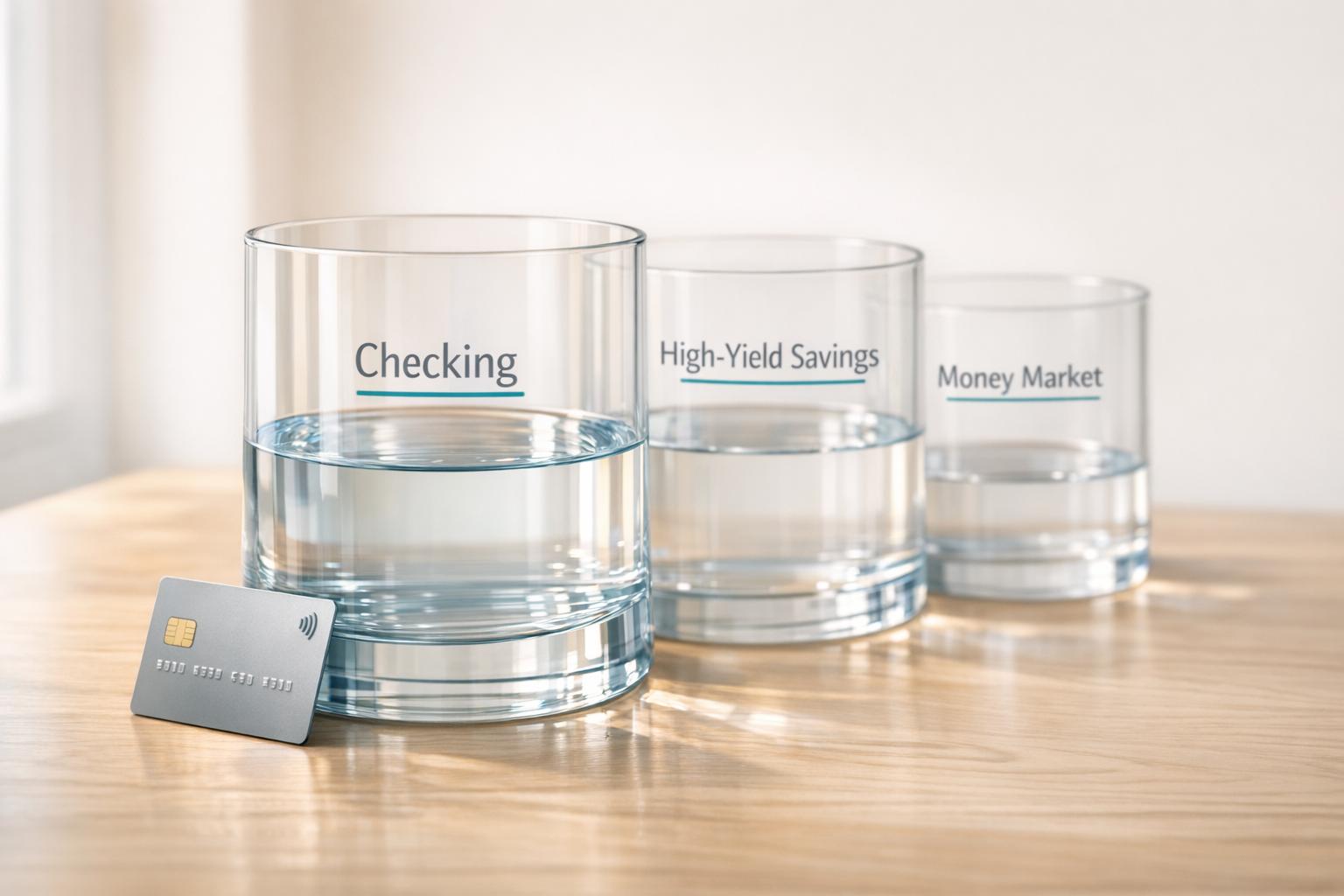
Liquidity is the ability to access your money quickly without losing its value. When emergencies hit - like medical bills, job loss, or urgent repairs - you need cash on hand, not assets tied up in investments or real estate. A liquid emergency fund ensures you're prepared for unexpected expenses without relying on high-interest debt or selling investments at a loss.
Key Takeaways:
- Emergency funds must be liquid: Prioritize accounts like high-yield savings or money market accounts for quick access.
- Avoid tying up money in investments: Stocks, retirement accounts, and real estate are harder to convert into cash quickly.
- Credit isn’t a reliable backup: High interest rates and reduced limits during downturns make it risky.
- Dedicated accounts are better: Mixing emergency funds with everyday money can lead to accidental spending.
Best Options for Emergency Funds:
- High-Yield Savings Accounts: Up to 5% APY, FDIC-insured, and accessible within 1-3 days.
- Money Market Accounts: Slightly lower APY but offer check-writing and ATM access.
- Standard Savings Accounts: Instant transfers but lower interest rates (~0.36%).
To calculate your emergency fund size, multiply your essential monthly expenses by 3-6 months. For example, if your monthly costs are $3,000, aim for $9,000 to $18,000. Adjust based on your job stability, family size, and financial risks. Start small if needed - $1,000 can cover minor emergencies while you build toward your goal.
Liquidity isn’t just about having cash - it’s about being ready for life’s surprises without derailing your financial future.
Common Problems with Emergency Fund Liquidity
Even if you understand the importance of having an emergency fund, keeping it accessible when you need it most can be tricky. Many people run into issues that make their funds harder to access quickly. Here are three common mistakes that can leave you scrambling for cash in a crisis.
Money Tied Up in Investments
Investments are great for growing your wealth, but they’re not ideal for emergencies. Market fluctuations can drastically reduce the value of your funds. For example, since 1990, the stock market has dropped an average of 13.7% from its peak each year. And during the 2008 financial crisis, even high-yield bonds - usually considered safer - fell by over 26%.
Another problem is settlement delays. Unlike cash in a savings account, selling stocks or mutual funds takes time. Once sold, it can take three to five business days for the funds to settle and become available. That’s far too long if you’re facing an urgent expense like a medical bill or car repair.
Retirement accounts are even less practical for emergencies. Withdrawing early from a 401(k) or traditional IRA comes with a 10% penalty, plus income taxes. Real estate is also unsuitable due to its lengthy selling process and high transaction fees.
"Stocks are volatile, with prices moving up or down daily by sometimes 3% to 4% or more, making them unsuitable for an emergency fund investment."
- Scott McClatchey, Senior Wealth Advisor, Ballast Rock Private Wealth
Relying on borrowed money for emergencies comes with its own set of risks.
Depending Too Much on Credit
Credit cards and loans might seem like a good backup plan, but they can lead to costly debt. Credit cards often have high interest rates, which means if you can’t pay the balance right away, the debt can snowball. This makes your emergency much more expensive in the long run.
Using too much of your credit limit can also hurt your credit score. A credit utilization ratio above 30% can lower your score, even if you’re making payments on time. In some cases, lenders might reduce your credit limit or close your account if they see you as a higher risk.
Perhaps the biggest issue is that credit isn’t always available when you need it most. During economic downturns, lenders often tighten credit limits or cancel lines of credit altogether, leaving you without options.
Disorganized Fund Storage
Mismanaging where you keep your emergency fund can also cause problems. If your money is scattered across multiple accounts or mixed with your everyday spending, it’s harder to access quickly. Keeping your emergency fund in the same account as your daily expenses increases the chance you’ll accidentally spend it. Without a dedicated account, it’s also harder to track when you’ve used your funds and need to replenish them.
Another issue is missing out on potential growth. While the national average APY for interest-bearing checking accounts is just 0.07%, some high-yield savings accounts offer rates over 5%. Storing your emergency fund in accounts with withdrawal restrictions, like CDs, can also lead to penalties or delays when you need the money immediately.
"By leaving funds in your normal checking account, they are more likely to be spent like normal savings and not be saved for emergencies."
- Nicole T. Strbich, Managing Director of Financial Planning, Buckingham Advisors
sbb-itb-02fd20a
Best Account Types for Emergency Funds

Emergency Fund Account Types: APY Rates, Access Speed, and Best Use Cases Comparison
Picking the right account for your emergency fund ensures your money stays safe, accessible, and earns interest. The ideal account offers liquidity, protects your principal, and provides returns.
High-Yield Savings Accounts
High-yield savings accounts are a top choice for emergency funds. As of February 2026, these accounts offer up to a 5% APY and are FDIC-insured (up to $250,000 per depositor), giving you both safety and a competitive interest rate. For example, a $15,000 emergency fund earning 4% interest could grow by about $623 in one year, thanks to compounding. Some platforms, like SoFi, even extend FDIC insurance up to $3 million through special deposit programs. These accounts often come with no monthly fees or minimum balance requirements, and funds can be accessed via electronic transfers.
However, transfers from high-yield accounts typically take one to three business days. To avoid delays when you need cash urgently, link your high-yield account to a local bank account for smoother transfers.
"The best place to keep that money is somewhere that's safe and accessible while earning a solid interest rate."
- Ryan Wilcox, Personal Finance Writer, The Motley Fool
Here are a few competitive options as of early 2026:
- SoFi Checking and Savings: Offers up to 4.00% APY with direct deposit and no monthly fees.
- CIT Platinum Savings: Provides 4.10% APY for balances of $5,000 or more (drops to 0.60% for lower balances).
- LendingClub LevelUp Savings: Features 4.00% APY with $250+ monthly deposits and no account fees.
For those who need direct spending access, money market accounts may be a better fit.
Money Market Accounts
Money market accounts combine the benefits of savings and checking accounts, making them a practical option for emergencies. They typically include debit cards, check-writing privileges, and fee-free ATM access. While their rates are slightly lower than high-yield savings accounts, they remain competitive. For instance, the Ally Money Market Account offers a 3.30% APY with no monthly fees. As of September 2024, the national average APY for money market accounts was 0.64%, but rates can vary widely.
One drawback is that money market accounts may require higher minimum balances to avoid fees. Additionally, some accounts limit the number of monthly withdrawals, so it's important to verify the terms before opening one.
"Money market accounts and high-yield savings accounts can fill an emergency fund 'very nicely.'"
- Scott McClatchey, Senior Wealth Advisor, Ballast Rock Private Wealth
Standard Savings Accounts
Standard savings accounts are a straightforward option, especially if you're just starting to build your emergency fund or maintaining a smaller balance. These accounts are often linked directly to checking accounts, allowing for instant transfers. However, their interest rates are typically low - around 0.25% to 0.36% - which means your money may lose value over time as inflation outpaces earnings. For a $15,000 emergency fund, the annual difference in earnings between a standard savings account and a high-yield account could exceed $550.
These accounts are best suited as a secondary tier for quick access. You can keep a small amount in a standard savings account for immediate needs while storing the majority of your emergency fund in a high-yield account to maximize growth.
| Account Type | Typical APY | Access Tools | Best For |
|---|---|---|---|
| High-Yield Savings | 4.00% - 5.00% | Electronic transfers, some ATM access | Maximizing interest while keeping cash safe |
| Money Market | 3.30% - 4.00% | Debit cards, check-writing, ATMs | Quick, direct spending during an emergency |
| Standard Savings | ~0.39% | Electronic transfers, ATM access | Small funds at a primary bank for instant transfers |
How to Calculate Your Emergency Fund Size
Figuring out the right size for your emergency fund is all about balancing accessibility with practicality. You want enough cash on hand to handle unexpected situations, but not so much that it hinders other financial goals.
Calculate Your Monthly Expenses
Start by identifying the essentials - expenses you absolutely need to cover, like housing, utilities, groceries, transportation, insurance, minimum debt payments, and medical costs. Take a close look at your spending over the past month to separate the "must-haves" from the "nice-to-haves". Tools like Monefy (https://monefy.com) can simplify this process by tracking and categorizing your expenses automatically. Don’t forget to account for annual costs like property taxes, car registrations, or insurance premiums. Divide these yearly expenses by 12 to get a monthly estimate.
To give you an idea, in 2023, the average U.S. household spent around $6,440 per month, with housing, food, and transportation making up 62.8% of that total.
Multiply by 3-6 Months
Once you know your monthly essentials, multiply that figure by three to six months to determine your emergency fund target. For instance, if your monthly essentials total $2,500, you’d need $7,500 for three months or $15,000 for six months. While three to six months is the general rule of thumb, some financial experts suggest using your monthly income as the multiplier for a more conservative approach.
Here’s a reality check: in 2023, only 54% of American adults had at least three months of emergency savings, and 57% couldn’t handle a $1,000 surprise expense without borrowing money. If building a full emergency fund feels overwhelming, start small. A "starter fund" of $1,000 to $2,000 can help you manage minor emergencies while you work toward your larger goal.
Adjust for Your Situation
After calculating a baseline, tweak it to fit your personal circumstances. Households with a single income, freelancers, and families with dependents usually need a larger cushion - think six to twelve months of essential expenses. If you’re self-employed, work in a volatile industry, or have ongoing health issues, aim for the higher end of the range.
Experts also suggest adding a 10% to 15% "risk buffer" to your target to account for unpredictable factors like rising energy costs or supply chain disruptions. As of 2023, the median unemployment period was about 8.6 weeks, but job searches for specialized roles often take longer.
Here’s a snapshot of different scenarios:
| Scenario | Monthly Essentials | Target Months | Total Fund Goal |
|---|---|---|---|
| Single Person, Stable Job | $2,500 | 3 months | $7,500 |
| Single Person, Freelancer | $2,500 | 6 months | $15,000 |
| Family of 4, One Income | $4,500 | 6 months | $27,000 |
| Family of 4, Self-Employed | $4,500 | 12 months | $54,000 |
Make it a habit to revisit your emergency fund target every year or whenever major life events occur - like getting married, having kids, buying a home, or paying off significant debt. A well-calculated emergency fund can provide peace of mind during tough times without derailing your long-term financial plans.
Balancing Liquidity with Long-Term Goals
Once you’ve built a solid emergency fund, the next step is making sure it doesn’t hold back your financial progress. While having cash on hand is essential for unexpected expenses, keeping too much of it idle can mean missing out on potential growth. The goal is to find the sweet spot between accessibility and earning potential.
Don't Hold Too Much Cash
While it might feel secure to hold large amounts of cash, it comes with a hefty price: missed opportunities. In 2026, with inflation hovering at 3.2% and index funds offering returns around 7.5%, the cost of holding excess cash adds up quickly. For instance, keeping $50,000 in a checking account could result in losing approximately $1,600 annually to inflation, while also missing out on potential market gains of $3,750. That’s a total annual loss of about $5,350.
"To be financially efficient in 2026, you must view your cash as an inventory management problem. Just as a grocery store doesn't want too much milk sitting on the shelf expiring, you don't want too much cash sitting in a low-interest account losing its value."
– Calcix Research Team
Inflation can significantly erode cash over time. At just 3% inflation, $100,000 in cash loses about half its purchasing power over 20 years. Once your emergency fund hits the recommended three to six months of essential expenses, any extra should go into investments with higher growth potential. SmartAsset echoes this sentiment: "Once your fund reaches the recommended amount, consider investing any excess savings in higher-growth options".
Use Multiple Savings Strategies
If holding too much cash stunts your financial growth, diversifying your savings plan can help. A tiered liquidity approach ensures you have access to cash while still earning better returns on the rest. One popular method is the "barbell strategy", where you keep about 1.5 months of expenses in a high-yield checking account for immediate needs and allocate the remaining 4.5 months to short-term instruments like 3- and 6-month Treasury bills or high-yield CDs.
Another method is CD laddering, where you spread your funds across multiple certificates of deposit with staggered maturity dates. This ensures regular access to funds while earning higher interest rates than traditional savings accounts. For example, you could divide $15,000 across five CDs that mature every three months.
A Roth IRA offers an additional layer of flexibility. Contributions can be withdrawn anytime without penalty, making it a dual-purpose tool for retirement savings and emergency funds. Christine Benz from Morningstar highlights this versatility: "People often assume that building a cash cushion means they'll have to hold off on investing for the long term. But that's not necessarily true: ... a Roth IRA can serve as a good multitasker because those contributions can be withdrawn without penalty".
You might also consider using credit lines, such as a HELOC or a dedicated credit line, as a secondary safety net. This approach can reduce the amount of stagnant cash you need to keep, allowing more of your money to stay invested. However, credit should only be a backup - not a replacement for your emergency fund.
When it comes to your core emergency fund, avoid volatile investments like stocks or cryptocurrencies. As Scott McClatchey, Senior Wealth Advisor at Ballast Rock Private Wealth, advises: "For emergency funds, it's just not worth the volatility and drawdown risk [of stocks]". Keep your emergency cash secure and accessible, but don’t let it stop you from growing your wealth in other areas.
How to Build and Maintain Your Emergency Fund
Building an emergency fund takes time and consistency, but you can make it easier by automating your savings.
Set Up Automatic Savings
Start by setting up automatic transfers from your paycheck to a high-yield savings account. Many employers allow you to split your direct deposit, so a portion of your paycheck goes straight into savings. If your employer doesn't offer this, schedule a recurring transfer from your checking account to your savings account the day after payday.
Begin with an amount that fits your budget. For instance, saving $50 a week adds up to about $2,600 in a year. Treat these transfers like a fixed monthly expense, similar to rent or a car payment. When you receive extra money, such as a tax refund or a bonus, consider using part of it to boost your emergency fund without affecting your regular budget.
Track Spending to Save More
Once your savings are automated, take a closer look at your expenses to see where you can save more. Track your spending for 60–90 days to identify areas of waste. Tools like Monefy can simplify this by categorizing your expenses and highlighting patterns.
For example, you might discover a forgotten $15 subscription, frequent delivery fees, or an unused gym membership. Canceling these expenses can free up extra cash. Then, increase your automatic savings by the same amount. You can even set up a dedicated "Emergency Fund" category in Monefy and add notes like "Netflix cancellation" or "bonus deposit" to track your progress.
Review Your Fund Regularly
As your savings grow, it's important to reassess your emergency fund to ensure it aligns with your needs. Review your balance and target amount at least once a year or after major life changes like getting married, having a child, buying a home, or switching jobs. During these reviews, update your calculations for essential monthly expenses. If your rent goes up or new costs arise, adjust your target. On the other hand, if you've eliminated a major expense, you might not need as much as before.
If you need to dip into your emergency fund, make replenishing it a priority. Smaller withdrawals (under $500) can often be replaced within a few months, while larger amounts (over $2,000) might take up to a year to rebuild. Regular reviews help keep your fund ready for unexpected expenses.
"Building an emergency fund isn't about finding extra money - it's about creating systems that make saving automatic and sustainable."
– Monefy
Track your progress monthly using tools like Monefy to stay motivated. Celebrate key milestones - whether it's reaching $500, $1,000, or covering one month's expenses. These smaller achievements can keep you encouraged and show that your system is working effectively.
Conclusion
An emergency fund is only as good as its accessibility. Liquidity isn't just a financial buzzword - it's the foundation of your safety net. By placing your emergency savings in high-yield savings accounts or money market accounts, you ensure quick access without worrying about penalties or market fluctuations.
The steps are simple: calculate your essential monthly expenses, multiply that by three to six months, and store the total in a separate, liquid account. Keep in mind that over 35% of Americans can't cover a $400 emergency with cash. High credit card interest rates can lead to a cycle of debt, but a well-planned emergency fund can help you avoid that pitfall.
"Liquidity is a tool, not a goal."
– Calcix Research Team
To protect your fund from losing value, avoid locking it into long-term investments. Instead, aim for accounts that balance accessibility with moderate growth - high-yield savings accounts offering up to 5.35% APY are a great option. Make it a habit to review your fund every six months, adjust for any life changes, and ensure you have adequate insurance to reduce the amount of cash you need readily available.
Use automated savings tools, track expenses with apps like Monefy, and stay consistent with periodic reviews. By prioritizing liquidity, you create a financial buffer that’s ready when you need it most - providing stability without compromising on growth. Start building your reserve today to secure your financial future.
FAQs
How liquid should my emergency fund be?
Your emergency fund needs to be easily accessible, which means it should be kept in a form that allows you to withdraw it quickly without facing fees or penalties. A savings account is a great option for this purpose, as it provides fast access when you need to cover unexpected costs.
Should I keep any emergency cash in my checking account?
Keeping some emergency cash in your checking account is smart because it gives you quick access to funds when unexpected expenses pop up. That said, there are a couple of downsides to consider. Checking accounts typically offer lower returns compared to other liquid assets, and inflation can gradually erode the purchasing power of the money you keep there.
How do I rebuild my emergency fund after I use it?
Rebuilding your emergency fund requires steady effort and smart strategies. Start by automating transfers directly from your paycheck into a high-yield savings account. Even small amounts - like $10 or $50 - add up over time.
Take a close look at your spending habits to identify areas where you can cut back on non-essential expenses. Redirect any unexpected cash, like tax refunds or work bonuses, straight into your savings. If possible, consider picking up a side gig to boost your income and accelerate your progress.
Make sure to keep your emergency savings in a high-yield account that's easily accessible. This way, you can earn more interest while still having quick access to your funds when you need them.