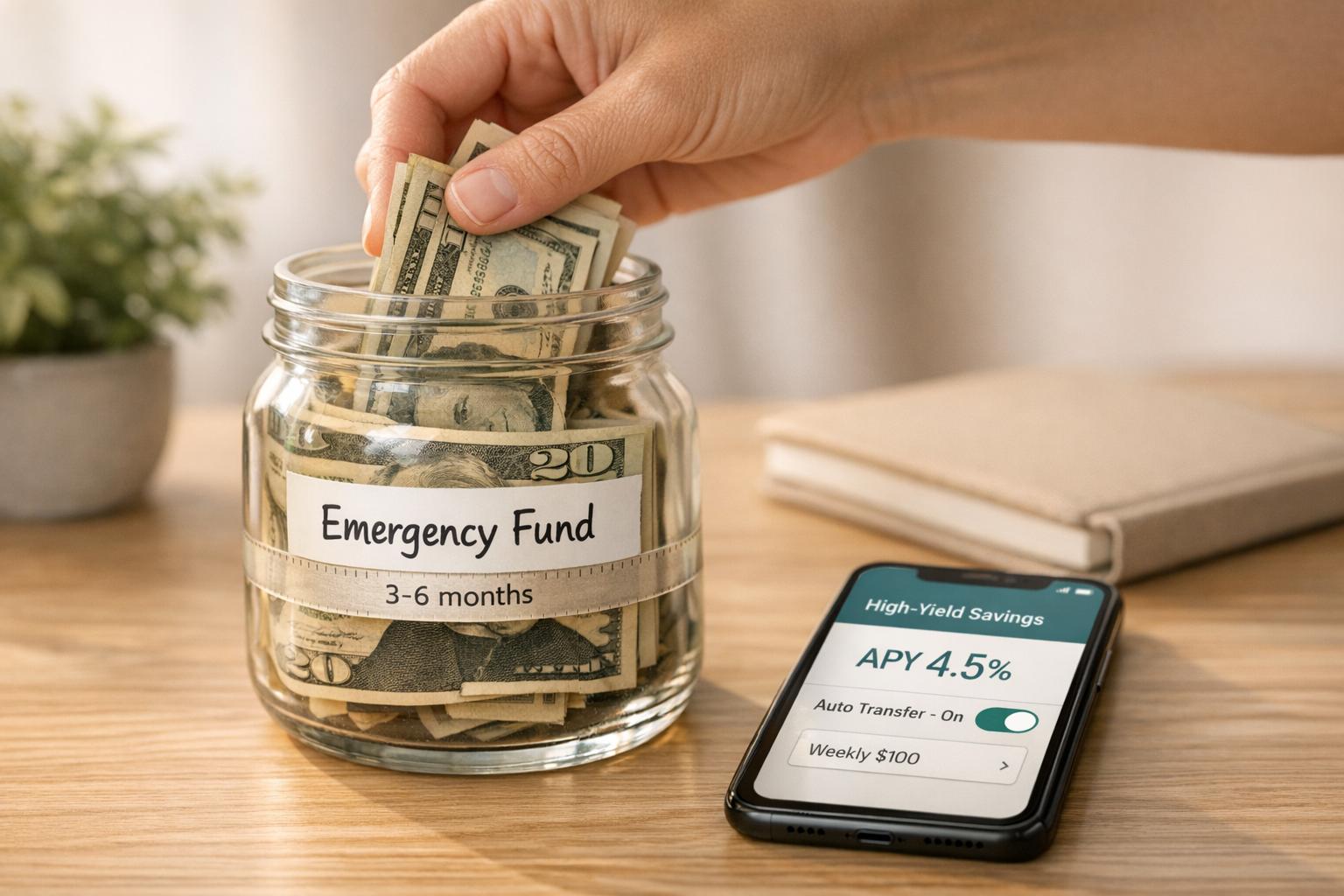
An emergency fund protects you from financial stress during unexpected situations like medical bills, car repairs, or job loss. But simply saving money isn’t enough - poor planning can leave you vulnerable. Common mistakes include saving too little, keeping funds in the wrong account, or not replenishing after use. Here’s how to build and maintain a reliable emergency fund:
- Calculate Your Target: Base it on essential monthly expenses (housing, utilities, groceries, etc.) and personal risks (job stability, dependents, or homeownership). Aim for 3–12 months of expenses depending on your situation.
- Choose the Right Account: Use high-yield savings accounts (4–5% APY) for safety, accessibility, and growth. Avoid risky or locked accounts like stocks or CDs.
- Keep It Separate: Open a dedicated account to avoid spending it on non-emergencies.
- Replenish After Use: Automate savings and redirect windfalls like tax refunds to rebuild quickly.
- Adjust Regularly: Update your fund to match inflation or life changes like moving or starting a family.
Start small if saving months of expenses feels overwhelming. Even $1,000–$2,000 can reduce financial stress significantly. Remember, the goal is to stay prepared without over-saving or losing growth opportunities.
Calculate Your Emergency Fund Target

Emergency Fund Target Calculator: How Much to Save Based on Your Situation
To build an emergency fund, you’ll need to calculate it based on your essential monthly expenses and personal risk factors. Let’s break it down.
Identify Your Monthly Expenses
Start by identifying the essential expenses your fund should cover. These include housing (rent or mortgage), utilities (like water, gas, electricity, and trash), groceries, insurance premiums, transportation (gas, public transit, or car payments), and minimum debt payments.
To get an accurate estimate, review your last 12 months of financial statements or track your expenses. Add up all these essential costs and divide by 12 to find your average monthly expense. This method also accounts for irregular but recurring costs, such as annual car registration, insurance premiums, or prescription medications. Be sure to exclude non-essential spending like dining out or entertainment.
For context, in 2023, the average U.S. household spent $77,280 annually, or roughly $6,440 per month. However, your emergency fund should reflect your actual spending habits. For instance, if you bring home $7,000 a month but only need $5,000 to cover essentials, base your calculations on that $5,000 figure.
Here’s how different scenarios might look:
| Scenario | Monthly Essentials | Target Months | Total Goal |
|---|---|---|---|
| Single Person, Stable Job | $2,500 | 3 months | $7,500 |
| Single Person, Freelancer | $2,500 | 6 months | $15,000 |
| Family of 4, One Income | $4,500 | 6 months | $27,000 |
| Family of 4, Self-Employed | $4,500 | 12 months | $54,000 |
Once you’ve calculated your essential monthly expenses, you can adjust this number based on your unique situation.
Adjust for Your Risk Factors
Your ideal emergency fund size depends on personal and professional risks. For example, if you have a stable, salaried job in a dual-income household, a three-month buffer may suffice. On the other hand, single-income families, freelancers, or those in industries prone to layoffs (like hospitality or tech) should aim for six to twelve months of expenses.
The average job search can take anywhere from 10 weeks to six months. If your job requires highly specialized skills or you work in a shrinking industry, it might take even longer to find a new position. Additionally, having dependents - whether children, elderly parents, or a non-working partner - means higher essential costs and a larger emergency fund.
Homeowners face added risks, such as unexpected repairs. Experts recommend setting aside 1%–3% of your home’s value annually for maintenance. If you have chronic health issues or a high-deductible insurance plan, it’s also wise to include your annual out-of-pocket maximum in your emergency fund.
"We are essentially a paycheck-to-paycheck nation. Fewer Americans have the financial safety net to cover inevitable unexpected expenses, despite low unemployment and steady growth."
- Mark Hamrick, Senior Economic Analyst, Bankrate
As of 2025, 57% of Americans still can’t cover a $1,000 unexpected expense with savings. If the idea of saving six months' worth of expenses feels daunting, start small. A $1,000–$2,000 mini-goal can help reduce financial stress. Once you’ve reached that milestone, keep building toward your full emergency fund based on your personal risk factors.
sbb-itb-02fd20a
Avoid Overfunding or Underfunding
Once you've calculated your emergency fund target, the next step is finding the right balance in your savings. Striking this balance is critical, especially when you consider that, as of February 2026, the median emergency savings balance for Americans is just $500. In fact, 43% of Americans couldn't handle a $1,000 emergency with their savings alone.
Risks of Underfunding
If your emergency fund isn't sufficient, unexpected expenses can quickly spiral into long-term debt. Without enough savings, many people rely on credit cards, which often carry interest rates between 20% and 28%. These new monthly payments can strain your budget, making it harder to save and leaving you even more exposed to future financial shocks.
For some, the lack of savings leads to tapping retirement accounts, which often results in a 10% penalty, taxes, and the loss of compound growth. Others might turn to home equity loans or lines of credit, putting their property at risk if they can't keep up with payments during an income shortfall.
Research highlights a key milestone: having $2,000 in savings can improve financial stability by 21%. This amount significantly reduces financial stress, and households often feel a notable sense of relief upon reaching this threshold. Interestingly, moving from $2,000 to $10,000 in savings doesn't provide the same level of stress reduction as hitting that initial $2,000 mark.
Risks of Overfunding
On the flip side, keeping too much cash in your emergency fund can also pose challenges. If you hold more than 12 months of expenses in a low-yield account, your money may lose value over time. For example, as of August 2025, the U.S. inflation rate was 2.9%. If your emergency fund earns just 2% interest, inflation effectively reduces your purchasing power every year.
"Keeping too much in low-interest savings is like letting inflation chip away at your money. Diversifying into assets like stocks and bonds helps preserve and even grow your purchasing power over time."
- Leon Huang, CEO, RapidDirect
There's also the issue of opportunity cost. Money sitting in a basic savings account could be used more effectively elsewhere - whether that's earning higher returns through investments, paying down high-interest debt, or taking advantage of your employer's 401(k) match. For instance, if you're paying 20% interest on credit card debt while your emergency fund earns just 1%, you're essentially losing 19% by over-saving.
Once you've reached your target - typically 3 to 12 months of essential expenses depending on your personal risk factors - consider redirecting additional savings. You could focus on retirement contributions, paying off debt, or even starting an "opportunity fund" for career growth. This strategy ensures your emergency fund remains intact while allowing your extra cash to support your long-term financial goals.
Choose the Right Account for Your Emergency Fund
Picking the right account for your emergency fund is crucial. You need a place that keeps your money safe, allows easy access, and earns enough interest to keep up with inflation. The wrong choice could leave you unprepared during a crisis or watching your savings lose value over time.
High-Yield Savings Accounts and Money Market Accounts
High-yield savings accounts (HYSAs) are an excellent choice for emergency funds. As of early 2026, HYSAs offer interest rates ranging from 4.00% to 5.35% APY. Compare that to the meager 0.07% APY you’d typically find in a checking account, and the difference is striking. For example, a $10,000 emergency fund in a HYSA could earn over $400 annually, while the same amount in a checking account would barely make $7.
Online banks often provide the best rates because they save on overhead costs compared to traditional banks. Plus, your deposits are FDIC-insured up to $250,000 per depositor, per institution. Transfers to your checking account usually take just one to two business days, offering a balance of security, accessibility, and competitive returns.
Money market accounts (MMAs) provide immediate access to your funds. These accounts blend features of checking and savings accounts, often including debit cards or check-writing capabilities. While the national average for MMAs sits around 0.64% APY, many institutions offer rates closer to those of HYSAs. Keep in mind, some MMAs require higher minimum balances to unlock better rates.
"An emergency fund has three jobs: be accessible, be safe, and earn enough interest to keep up with inflation."
- Joel O'Leary, Personal Finance Writer, Motley Fool Money
Cash management accounts (CMAs) are another option to consider. Offered by brokerages, CMAs combine checking and savings features while delivering competitive rates and SIPC protection. These are particularly appealing if you already manage your finances through an investment platform and want to streamline your accounts.
Each of these options balances safety, accessibility, and the potential for growth, making them solid choices for emergency savings.
Avoid Risky or Inaccessible Accounts
The stock market is not a safe place for emergency funds. While stocks can grow over time, their volatility makes them unreliable for money you might need quickly. A market downturn could force you to sell at a loss just when you need the cash most.
Certificates of deposit (CDs) limit your access. Most CDs impose penalties for early withdrawals, which can eat into your savings. Even "no-penalty" CDs restrict immediate access, which is a critical feature for an emergency fund.
Retirement accounts should not be used for emergencies. Tapping into a 401(k) or IRA often triggers a 10% penalty, plus taxes, and you lose the benefit of long-term compound growth. As Jeremy Schneider, Founder of Personal Finance Club, explains: "It shouldn't be invested. If it's invested, it's not your emergency fund".
Series I savings bonds might seem attractive because they adjust for inflation, but they’re not ideal for emergencies. You can’t access the funds for at least a year, and withdrawing within five years means losing the last three months of interest. This lack of liquidity makes them unsuitable for immediate needs.
The table below highlights why liquidity and accessibility should take priority over chasing higher returns:
| Account Type | Accessibility | Interest Potential | Safety (FDIC/NCUA) | Primary Risk for Emergencies |
|---|---|---|---|---|
| High-Yield Savings | Very High | 4.00%–5.35% APY | Yes | Rates can change over time |
| Money Market Account | High | Moderate to High | Yes | May require high minimum balances |
| Certificate of Deposit | Low | High | Yes | Early withdrawal penalties |
| Stock Market | Moderate | Variable | No | Market volatility and potential loss of principal |
| Retirement Accounts | Low | Variable | N/A | Taxes, penalties, and lost compound growth |
Choosing the right account ensures your emergency fund is ready when you need it most.
Keep Your Emergency Fund Separate
Once you've chosen the right account, it's essential to keep your emergency fund isolated to ensure it serves its intended purpose. Mixing this fund with your regular checking account can drain it faster than you'd think. When your emergency savings sit alongside your day-to-day spending money, that $5,000 safety net might start feeling like "extra" cash. Suddenly, it’s easier to justify dipping into it for non-urgent purchases, like a weekend getaway or the latest gadget.
"By leaving funds in your normal checking account, they are more likely to be spent like normal savings and not be saved for emergencies." - Nicole T. Strbich, Managing Director of Financial Planning, Buckingham Advisors
The fix? Open a separate account specifically for your emergency fund - ideally at a different bank than your main checking account. This creates a "psychological wall", making it less tempting to raid your savings for everyday wants. This simple step helps you stay disciplined, ensuring the money is reserved for true emergencies.
Here's another incentive: most standard checking accounts offer a meager 0.07% APY, meaning a $10,000 emergency fund would earn just $7 annually. But if you move that same amount into a high-yield savings account offering 4.00% to 5.35% APY, you could earn between $400 and $535 a year. Not only does this grow your fund, but it also keeps it out of easy reach for impulse spending.
The idea is to add just enough of a barrier to prevent unnecessary withdrawals while still keeping the funds accessible when you genuinely need them. Transfers from high-yield accounts usually take one to two business days, giving you a built-in "cooling-off" period before accessing the money.
To streamline your savings, set up automatic transfers from your checking account to your dedicated emergency fund. Clearly label the account as "Emergency Fund" in your banking app, and avoid linking a debit card to it. These small steps can go a long way in protecting your financial safety net.
Replenish Your Emergency Fund After Use
Using your emergency fund serves its purpose, but the key is to rebuild it quickly. Without a plan to restore it, you could find yourself relying on high-interest credit cards or loans when the next emergency strikes - a cycle that’s hard to escape.
Make Consistent Contributions
The simplest way to rebuild your fund is through automatic transfers. Set up a direct deposit split or schedule transfers from your checking account to your emergency savings right after payday. Even modest amounts, like $20 or $30 per paycheck, can add up over time without putting a strain on your daily budget. Financial advisor Jason Fannon explains it well: "Automation lets the money move before you can talk yourself out of it".
"If you don't have the emergency reserve but more unexpected expenses come up, you're digging yourself deeper into the hole, which means spending more on credit cards and even withdrawing from your retirement funds." - Derek Ripp, Certified Financial Planner and Partner, Austin Wealth Management
To speed up the process, consider temporarily redirecting extra debt payments or retirement contributions (beyond employer matches) to your emergency fund. This isn’t a permanent change - just a temporary adjustment to rebuild your safety net more quickly.
Another smart move? Redirect surplus funds. For example, if you’ve recently paid off a car loan or credit card, funnel that same monthly payment into your emergency fund. Likewise, channel any windfalls, like tax refunds, work bonuses, or cash gifts, directly into savings. On average, it takes just over a year to fully rebuild a six-month emergency fund.
By automating your savings and redirecting unexpected funds, you can rebuild your safety net without overthinking it.
Remember the Value of a Safety Net
Replenishing your emergency fund doesn’t just restore your savings - it strengthens your financial stability. Studies show that having just $2,000 in emergency savings can provide a sense of security comparable to having $1 million in total assets. With that cushion, you’re less likely to panic during a crisis or make rushed financial decisions.
"Your emergency fund is less about that broken water heater than about peace of mind." - Marc Russell, Financial Coach and Founder, BetterWallet
To make your savings work harder, keep your fund in a high-yield savings account earning at least 4.2% interest, rather than a traditional account with a much lower yield, like 0.39%. This way, your money grows while staying accessible. Naming your account something like "Rainy Day Reserve" can also help create a mental barrier, reducing the temptation for casual withdrawals. Regularly checking your balance can reinforce your sense of financial security and peace of mind.
Review and Adjust Your Emergency Fund Regularly
Your emergency fund isn’t a “set it and forget it” kind of thing. It needs regular attention to stay effective. What covered your expenses a couple of years ago might not cut it today, especially if you’ve moved to a pricier area, started a family, or changed jobs. Regular check-ins ensure your fund keeps pace with your evolving financial needs.
Set a Regular Review Schedule
Make it a habit to review your emergency fund at least twice a year. Many financial experts suggest tying this task to a specific date - like your birthday or the start of the year - to make it easier to remember. Some people even do a quick check at the start of every month to ensure their spending patterns still align with their fund.
"You want to re-evaluate your emergency fund anytime there is a change to your expenses." - Kendall Meade, Certified Financial Planner, SoFi
During these reviews, take a fresh look at your essential monthly expenses - things like housing, utilities, groceries, insurance, and minimum debt payments. If costs have risen due to inflation or lifestyle changes, it’s time to adjust your target.
Adjust for Life Changes
Beyond regular reviews, it’s critical to reassess your emergency fund immediately following major life changes. Events like getting married, having a child, buying a home, or switching to freelance work can significantly increase your essential expenses. For example, owning a home brings unexpected repair costs - like fixing a broken furnace or dealing with a leaking roof - that renters don’t typically face. Similarly, adding a child to your family means higher recurring costs for food, healthcare, and childcare.
"The greater your fixed expenses and the harder your job would be to replace... the larger your emergency fund needs to be." - Christine Benz, Director of Personal Finance, Morningstar
On the flip side, some changes might allow you to shrink your fund. For instance, moving from a single-income household to a dual-income one could reduce your target from six months of expenses to three, as the financial burden is now shared. Whether it’s a pay raise, job loss, or a move to a lower-cost area, recalculating your needs when circumstances shift is key to keeping your emergency fund on track.
Avoid Common Emergency Fund Mistakes
Even with a solid plan, certain missteps can weaken the effectiveness of your emergency fund. Understanding these common errors - and learning how to avoid them - can help you stay financially secure when unexpected situations arise.
Mixing Funds with Other Savings
One major error is keeping your emergency fund in the same account as your everyday spending or general savings. Without clear separation, it's easy to dip into these funds for non-emergencies, like holiday shopping or a spontaneous getaway.
"When your emergency fund lives in the same account you use for everyday spending, it tends to slowly disappear. A separate HYSA keeps it earmarked and protected." - Joel O'Leary, Full-Time Personal Finance Writer, Motley Fool Money
By using a dedicated account - ideally at a different bank - you create a barrier that helps protect your emergency savings. Plus, a high-yield savings account (HYSA) can grow your fund with better interest rates.
Underestimating Your Expenses
Another common mistake is basing your emergency fund solely on regular monthly bills while ignoring irregular but essential expenses. Costs like annual insurance premiums, car repairs, medical deductibles, property taxes, and home maintenance can quickly add up. For example, if you spend $1,200 annually on car insurance and face a $2,000 deductible, that’s an additional $267 per month you might need to account for.
Unfortunately, many people underestimate these costs. In fact, only 44% of Americans could handle a $1,000 emergency from their savings. This often happens because they fail to calculate their true essential expenses.
Failing to Account for Inflation
An emergency fund that seemed sufficient years ago may no longer hold up today. Inflation gradually reduces the purchasing power of money. For instance, if you saved $5,000 back in 2015 and haven’t adjusted it since, that amount likely covers much less now. With the U.S. inflation rate at 2.9% as of August 2025, it’s crucial to regularly update your savings target.
"Inflation gradually reduces what your savings can buy. If you saved three months of expenses five years ago but haven't adjusted, you might now only have 2.5 months of purchasing power." - Mathew Lepan, Author
To keep up, review your emergency fund annually and adjust it based on current expenses. Rising costs - whether from rent, groceries, or utilities - may require increasing your savings contributions. Parking your fund in a high-yield savings account earning 4–5% APY can also help counteract inflation. Tools like Monefy can track your expenses over time, making it easier to spot when inflation has pushed your costs higher. Regular updates ensure your fund stays aligned with your financial reality.
Conclusion
Having an emergency fund is like a safety net - it shields you from high-interest debt and keeps your long-term financial goals on track. When unexpected expenses arise, having readily available cash can mean the difference between financial stability and stress. This guide has walked through the key steps to building that safety net, from setting your savings goal to selecting the best account for your needs.
The secret to success lies in steady contributions. Start small if needed, automate your savings to make it effortless, and keep your emergency fund separate from your daily spending. As Jeremy Zuke of Abundo Wealth puts it: "An emergency fund is what stands between you and high-interest debt".
Make it a habit to review and adjust your fund annually. Factors like inflation, life changes, and increasing costs can quickly render your original target outdated. For example, a fund that covered three months of expenses in 2020 might only last 2.5 months by 2026. Using tools like Monefy can help you monitor your expenses and ensure your savings align with your current needs.
Lastly, don’t fall into the trap of overfunding. Once you’ve hit your target, redirect any additional savings toward paying down high-interest debt or investing for the future. As Raihan Masroor, Founder and CEO of Your Doctors Online, wisely says: "True financial security comes from balance, not from hoarding money".
FAQs
What counts as a real emergency?
A real financial emergency is an unforeseen, urgent situation that demands immediate funds and doesn’t allow for budget adjustments. These situations might include medical emergencies, job loss, urgent car repairs, unexpected housing costs, or emergency travel. They often come out of nowhere and directly affect critical areas like health, housing, or basic survival.
How fast should I rebuild my fund after using it?
Rebuilding your emergency fund should be a top priority, tailored to your current financial situation. Begin by setting up a budget that outlines your income and essential expenses. Track where your money goes and identify areas where you can cut back. Commit to saving consistently, even if it’s a small amount at first. Gradually increase these contributions as your financial circumstances improve. The goal is to replenish your fund within a few months, so you’re ready to handle any unexpected costs that come your way.
Should I pay off high-interest debt before saving more?
When deciding between saving or paying off debt, it really comes down to your personal circumstances. Many financial experts suggest tackling high-interest debt first - like credit card balances - because the interest charges often outweigh any potential gains from savings.
That said, it’s crucial to have an emergency fund in place. Aim for enough to cover three to six months of essential expenses. This safety net can protect you from unexpected costs, like medical bills or car repairs. Once you’ve built that buffer, redirect your focus to paying off high-interest debt. Doing so can help you save more over time by cutting down on those costly interest payments.