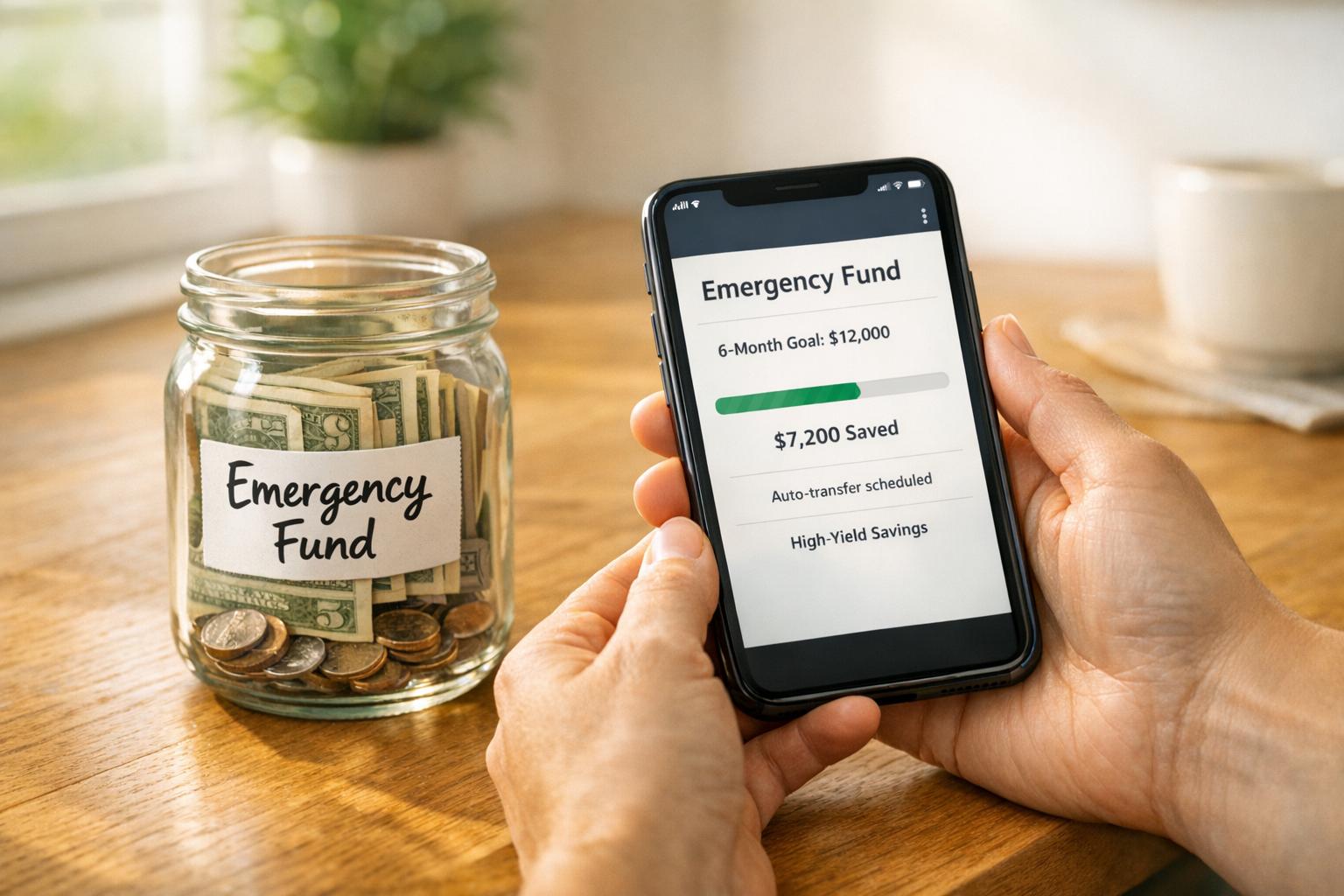
Building an emergency fund is one of the most important steps toward financial security. It helps you handle unexpected expenses - like medical bills, car repairs, or job loss - without relying on high-interest debt. Here's what you need to know:
- Start small: Aim for $500–$1,000 initially, then work toward 3–6 months of essential expenses.
- Calculate your goal: Add up your monthly essentials (e.g., rent, utilities, groceries) and multiply by the number of months you want to cover.
- Make saving automatic: Set up recurring transfers to a high-yield savings account to grow your fund consistently.
- Use windfalls wisely: Allocate bonuses, tax refunds, or extra income to your fund for faster progress.
- Keep it separate: Store your fund in a high-yield savings account to earn interest and avoid spending it impulsively.
Why You Need an Emergency Fund
An emergency fund is your financial safety net, shielding you from the chaos that unexpected expenses can bring. Without this cushion, a single surprise cost could force you to rely on high-interest credit, potentially trapping you in a cycle of debt that's tough to break. Even making minimum payments on that debt can deepen financial strain.
The statistics are eye-opening: as of May 2024, 27% of adults had no emergency savings at all. Even more alarming, by 2025, 59% of Americans didn’t have enough saved to cover a $1,000 emergency. This leaves millions teetering on the edge of financial instability, vulnerable to unexpected events that can throw their budgets into disarray.
"We are essentially a paycheck-to-paycheck nation. Fewer Americans have the financial safety net to cover inevitable unexpected expenses, despite low unemployment and steady growth."
– Mark Hamrick, Senior Economic Analyst, Bankrate
But it’s not just about dollars and cents - there’s a mental toll too. Studies show that having $2,000 in emergency savings can significantly reduce financial stress and improve overall well-being. That sense of security - knowing you can handle life’s surprises without jeopardizing your long-term goals - is priceless.
Let’s dive into the types of emergencies this fund is built to handle and why it’s a game-changer for financial stability.
Common Emergencies Covered by an Emergency Fund
Life is unpredictable, and an emergency fund is there to catch you when surprises come your way. Here are some of the most common scenarios where this fund can make all the difference:
- Medical Expenses: Sudden illnesses, emergency dental work, or medical bills that insurance doesn’t fully cover can add up quickly.
- Job Loss or Income Disruption: Losing your job or facing a temporary income gap can be devastating, but having three to six months of expenses saved allows you to navigate this period without rushing into a less-than-ideal job.
- Home Repairs: Issues like a leaking roof or a broken water heater often need immediate attention, and quick access to funds can prevent further damage.
- Auto Repairs: Essential car repairs, especially those impacting safety, can’t wait.
- Urgent Travel: Unexpected trips, such as flying home for a family emergency, are another common reason to dip into your savings.
Every dollar in your emergency fund helps you face these situations with confidence, avoiding the stress of scrambling for funds when time is of the essence.
Financial Security vs. Living Paycheck to Paycheck
Living paycheck to paycheck leaves no room for surprises. An emergency fund transforms those surprises from crises into manageable bumps in the road. It protects you from dipping into retirement accounts - avoiding tax penalties and preserving your financial future - and ensures you retain control over your financial decisions during tough times.
People with emergency savings recover faster from setbacks and are less likely to spiral into debt. Even starting small, with $500 to $1,000, can cover basic needs like minor car repairs or medical copays without resorting to credit cards. From there, building toward one month of expenses, then three, and eventually six months creates a solid financial buffer. These layers of protection not only reduce stress but also provide long-term stability and peace of mind.
sbb-itb-02fd20a
Setting Your Emergency Fund Goal

Emergency Fund Savings Goals by Household Type and Income Stability
Determining your emergency fund goal comes down to evaluating your monthly essentials, income stability, and whether you have dependents. Focus on covering basic needs - such as rent or mortgage, utilities, groceries, transportation, insurance premiums, and minimum debt payments - rather than aiming to replace your entire paycheck.
The general guideline is the 3-to-6 month rule. If you have a stable salaried job and a working partner, three months of essential expenses may suffice. On the other hand, if you're self-employed, the sole earner, or work in an unpredictable industry, aim for at least six months. Freelancers and business owners often target 9 to 12 months due to fluctuating income.
Starting can feel daunting, especially when the average U.S. household spends about $6,440 per month. To make it manageable, many financial advisors recommend beginning with a smaller cushion, such as $1,000 to $2,000, to handle minor emergencies. Research shows that reaching $2,000 can significantly ease financial stress, even if you're far from the full 3-to-6 month goal. From there, aim for one month of expenses, then three months, and eventually six. Next, let’s break down how to calculate your target and adjust it as your life changes.
How to Calculate Your Target Amount
Start by listing your essential monthly expenses. These include housing, utilities, groceries, transportation, insurance, and minimum debt payments. Leave out non-essentials like streaming subscriptions, gym memberships, and dining out.
Once you have your monthly essentials total, multiply it by the number of months you want to cover. For example:
- Use 3 months if you have a stable job, dual income, and no dependents.
- Opt for 6 months or more if you're self-employed, have dependents, work in a niche field where job searches take longer, or face high medical costs.
Specialized professionals, for instance, may need a larger cushion since job searches in their fields can last anywhere from 10 weeks to 6 months.
Make it a habit to review your target annually or after major life changes, like getting married, having a child, or facing rising costs due to inflation. Your emergency fund should evolve with your life.
Sample Emergency Fund Targets
Here’s a look at how different households might calculate their savings goals based on estimated 2025–2026 costs:
| Household Scenario | Monthly Essential Expenses | Target Months | Total Savings Goal |
|---|---|---|---|
| Single, Stable Salaried Job | $2,500 | 3 Months | $7,500 |
| Single, Freelancer/Variable Income | $2,500 | 6 Months | $15,000 |
| Family of 4, Dual Income | $4,500 | 3 Months | $13,500 |
| Family of 4, Single Income | $4,500 | 6 Months | $27,000 |
| Self-Employed with Dependents | $5,000 | 9–12 Months | $45,000–$60,000 |
These examples provide a useful starting point for setting your own goal. Your situation might differ, but the key is to honestly assess your monthly spending and potential risks. Even if the final goal feels out of reach, every dollar saved brings you closer to financial peace of mind.
Building Your Emergency Fund: Step-by-Step
Once you've set your savings goal, it’s time to get to work. The key? Consistently setting money aside. Building an emergency fund doesn’t require a complete lifestyle overhaul - it’s about creating a system that fits your budget and simplifies the process. Here are three practical strategies: budgeting to free up cash, automating your contributions, and using windfalls wisely.
Create a Budget to Free Up Savings
Before you can save, you need to understand where your money is going. A simple framework like the 50/30/20 rule can help: dedicate 50% of your income to needs (housing, utilities, groceries), 30% to wants (entertainment, dining out), and 20% to financial goals like your emergency fund or debt repayment. If money is tight, even starting with 10% for savings can make a difference.
To identify areas for savings, track your spending for two weeks. Patterns will emerge - maybe you’re spending $150 a month on unused subscriptions or $200 on impulse purchases. Cancel those subscriptions or cut back on non-essentials, and redirect that money directly into your emergency fund.
Apps like Monefy can make this process visual and motivating. Create a category specifically for your emergency fund, and log every contribution as income. Use the notes feature to label entries like "Canceled gym membership" or "Reduced takeout spending" to see exactly how your changes are paying off. Watching your savings grow can be a huge motivator.
Automate Your Savings Contributions
Automation is a game-changer because it removes the temptation to spend. Treat your emergency fund contributions like a non-negotiable bill that gets paid first. The easiest option? Ask your employer to split your direct deposit so a portion of your paycheck goes directly into a separate high-yield savings account.
"I strongly recommend automating your monthly contribution because when you never see the money, it's easier to avoid accidentally spending it." – Jeremy Zuke, Financial Planner, Abundo Wealth
If splitting your paycheck isn’t an option, set up a recurring bank transfer that happens right after payday. Even small amounts add up - saving just $5 a day can grow to $1,825 in a year. As your income grows or you pay off debt, increase your automated savings to keep your momentum going.
Apps like Monefy can help you track these automated transfers. Label them as "Bi-weekly auto transfer" or "Paycheck split" to distinguish them from other contributions. To avoid overdraft fees, set up alerts or reminders to ensure your checking account has enough to cover the transfer.
Use Windfalls and Extra Income
Unexpected money - like tax refunds, bonuses, or cash gifts - is a great way to boost your savings. Commit to putting at least 50% of any windfall into your emergency fund. For example, if you get a $1,200 tax refund, immediately save $600 and use the rest for other goals or discretionary spending.
This strategy works because windfalls are "extra" money - they weren’t part of your regular budget, so saving them doesn’t disrupt your daily life. A $1,000 bonus, for instance, could help you hit a $500 starter fund goal or cover a significant portion of a $2,500 target. Even smaller amounts, like cashback rewards or the money freed up from paying off a loan, can make a difference.
To avoid spending windfalls impulsively, transfer them to your high-yield savings account immediately. Use tools like Monefy to log the source (e.g., "Annual bonus" or "Freelance gig payment") so you can track how much these one-time contributions accelerate your progress. This approach helps you stay focused on your goal. In 2023, only 63% of Americans could handle a $400 emergency expense with cash, so every little bit you save brings you closer to financial stability.
Once your emergency fund is growing, the next step is finding the best savings account to keep it secure and accessible.
Choosing the Right Savings Account
As your emergency fund grows, picking the right account to store it is essential. The account you choose should strike a balance between keeping your money accessible and helping it grow through interest. A high-yield savings account (HYSA) is often a great choice because it not only earns more interest but also helps you avoid dipping into your savings for everyday expenses. The goal is clear: ensure your money is safe, accessible when needed, and working for you.
High-Yield Savings Accounts vs. Checking Accounts
When it comes to emergency funds, high-yield savings accounts (HYSAs) are a clear winner. As of March 2026, online HYSAs offer interest rates ranging from 4.00% to 5.00% APY. Compare that to traditional savings accounts, which offer a mere 0.01% to 0.50% APY. To illustrate, a $10,000 emergency fund would earn just $1 annually in a traditional account versus $400 to $500 in an HYSA.
On the other hand, checking accounts are designed for daily transactions, not savings. They typically offer little to no interest and make it far too easy to spend your emergency fund on non-essential expenses.
| Feature | Checking Account | High-Yield Savings Account (HYSA) |
|---|---|---|
| Intended Use | Daily spending and bills | Short-term savings and emergencies |
| Interest Rate | Typically 0% or near-zero | High (4.00%–5.00% APY) |
| Access | Debit card, checks, ATMs | Electronic transfers, some ATMs |
| Spending Risk | High (easy to spend) | Low (separate from daily cash) |
| Safety | FDIC/NCUA Insured | FDIC/NCUA Insured |
Most HYSAs allow same-day or next-day transfers, ensuring your funds are available within 1–2 business days. Always confirm that the bank or credit union is FDIC-insured or NCUA-insured, which protects deposits up to $250,000 per depositor.
"Shopping for a new high-yield savings account can be overwhelming when the options seem endless. See what your current bank offers first - you might be able to score some kind of higher loyalty rate as a current customer." – Tanza Loudenback, CFP®
Tips for Keeping Your Emergency Fund Separate
Keeping your emergency fund separate from your everyday accounts is crucial for safeguarding it. When your savings share space with your daily spending money, it’s easy for the balance to shrink due to routine expenses like groceries or bills. A dedicated high-yield savings account creates a clear boundary, making it harder to accidentally or impulsively dip into your emergency fund.
For even more protection, consider opening the account at a different bank than where you hold your primary checking account. This adds an extra layer of separation, as transferring money will take 1–2 business days - giving you time to assess whether the situation truly qualifies as an emergency.
You can also personalize the account by nicknaming it something like "Emergency Fund Only" or "Do Not Touch – Emergencies." This simple step reinforces its purpose every time you log in. Using budgeting apps like Monefy can also help you track your progress by creating a dedicated category for your emergency fund, keeping you motivated and focused.
"When your emergency fund lives in the same account you use for everyday spending, it tends to slowly disappear. A separate HYSA keeps it earmarked and protected." – Joel O'Leary, Full-Time Personal Finance Writer, Motley Fool Money
Finally, define clear rules for what constitutes an emergency - such as job loss, unexpected medical expenses, or urgent car repairs - and what does not, like vacations or new gadgets. Write these rules down and keep them visible. This clarity ensures your emergency fund remains intact for genuine emergencies.
Overcoming Common Challenges
Building an emergency fund is rarely straightforward. Even with the best intentions, challenges like tight budgets, unexpected withdrawals, or losing motivation can arise. The good news? These obstacles come with practical solutions.
Starting Small on a Tight Budget
For those living paycheck to paycheck, saving thousands of dollars might feel out of reach. But starting small can make all the difference. Only 44% of Americans can handle a $1,000 emergency expense from savings. That’s why starting with a modest goal, like $100 to $500, is a smart first step. This amount can cover minor emergencies like a flat tire or a prescription copay.
Even saving just $5 a day adds up to $1,825 in a year. One simple strategy is to "hide" money from yourself. For instance, if your paycheck is $678.40, budget as if it’s $670 and save the extra $8.40. Other small changes - like earning cashback through apps or canceling unused subscriptions - can help you save $50 or more in just a few months.
Here’s a real-world example: Jasmine, who earns $2,300 a month, saved $560 in five months by cutting out a $7 weekly coffee habit, automating a $10 weekly transfer, and selling unused clothing.
"It is pretty daunting for many people to even think about having three months of living expenses because that goal can seem insurmountable... Even if it's just putting away $25 a month or $50 a month, it's a positive step." – Laura Adams, Host, Money Girl Podcast
Treat your savings like a bill you have to pay. Automate small contributions, even if it’s just $5 or $10 per payday. Over time, the impact adds up:
| Weekly Contribution | Annual Total | Covers Examples Like |
|---|---|---|
| $5 | $260 | Minor car repair or appliance fix |
| $10 | $520 | Common medical copays |
| $20 | $1,040 | Major car repair or emergency travel |
| ~$35 (about $5/day) | $1,825 | A solid buffer against job loss |
Once you’ve built a starter fund, the next hurdle is replenishing it after it’s been used.
Rebuilding After Using Your Emergency Fund
Using your emergency fund doesn’t mean failure - it’s there for exactly that purpose. The key is to prioritize rebuilding it afterward, so you’re ready for the next unexpected expense. Without replenishment, you risk relying on high-interest debt during future emergencies.
Start by reviewing how much you withdrew and set a realistic timeline to rebuild. For smaller withdrawals under $500, aim to replenish within two months. Larger amounts over $2,000 might take up to a year.
Consider a temporary spending freeze by cutting non-essential expenses like dining out, subscription boxes, or entertainment for a month. Redirect every saved dollar into your emergency fund. Meal planning alone can save $100 to $300 a month on groceries. If you have a side hustle, channel those earnings directly into rebuilding your fund.
Windfalls like tax refunds, bonuses, or birthday cash are also great opportunities. Commit at least 50% of these amounts to your emergency fund before they get absorbed into your budget. Selling unused items on platforms like Facebook Marketplace or Poshmark can also generate quick cash.
"A savings account is designed to be spent. If clients use the money in their emergency fund for a surprise expense, that's okay because that's what it's there for. Life happens and we can't predict the impact. Try not to feel guilty about that." – Derek Ripp, Certified Financial Planner, Austin Wealth Management
To stay organized, consider using apps like Monefy to track your progress. Create a dedicated "Emergency Fund Rebuild" category and log each contribution with notes like "Tax refund allocation" or "Side hustle earnings." This helps you identify which strategies work best.
Staying Motivated with Progress Tracking
Saving for months - or even years - can feel exhausting. Breaking your goal into smaller, achievable milestones can keep you motivated. Instead of focusing on a long-term target like $10,000, aim for incremental goals: $500, then $1,000, then $2,500. Each milestone provides a tangible sense of progress.
Apps like Monefy can help you stay on track by syncing your progress across devices. Use features like goal reminders and contribution notes to review what’s working - whether it’s an automated transfer or a bonus allocation. Visualizing your growing balance can reinforce your efforts.
Celebrate these milestones with simple, budget-friendly rewards. A movie night at home or a favorite homemade meal can make the journey feel less like a chore. Before dipping into your fund, consider implementing a 24-hour waiting period to ensure the expense qualifies as a true emergency.
"An emergency fund of a few thousand dollars is an amazing start." – Jeremy Zuke, Financial Planner, Abundo Wealth
Regular check-ins - monthly or quarterly - help you adjust contributions as your income or expenses change. This ensures your fund stays aligned with your financial needs and goals.
Maintaining and Adjusting Your Emergency Fund
Once your emergency fund is established, the work doesn’t stop there. It’s essential to keep it in sync with your evolving financial situation. This means setting clear rules for when to use it and regularly reviewing its size to ensure it meets your current needs.
Set Clear Rules for Using Your Emergency Fund
Before tapping into your emergency fund, apply a simple three-point test: the expense must be Unexpected, Necessary, and Urgent. Here’s how these criteria break down:
- Unexpected: An expense you didn’t plan for, like a sudden car repair.
- Necessary: It impacts your health, safety, housing, or income. For example, fixing a leaky roof qualifies, but replacing a dishwasher doesn’t if you can wash dishes by hand.
- Urgent: Delaying action would result in greater harm or higher costs.
"An emergency fund is the shock absorber of a household budget."
Some situations fall into a gray area. For instance, a last-minute flight to visit a sick relative or a hefty vet bill might feel urgent, but it’s worth pausing to evaluate whether they’re truly necessary. Before withdrawing funds, explore alternative payment options. If you find yourself dipping into your emergency fund more than twice a year for non-emergencies, it’s time to revisit your budgeting habits.
Now, let’s look at how to adjust your fund as your life changes.
Annual Review and Adjustments
Make it a habit to review your emergency fund every year - or whenever major life events occur, like a new job, a raise, or family changes. The goal is to ensure your fund covers only essential expenses. For instance:
- If you switch to freelance work or another job with irregular income, you’ll need a larger safety net.
- A raise or promotion may increase your living costs, so your fund should grow accordingly.
"The greater your fixed expenses and the harder your job would be to replace (because it's specialized and/or higher paying), the larger your emergency fund needs to be."
– Christine Benz, Director of Personal Finance, Morningstar
Life changes like getting married, having a child, or caring for aging parents often call for a bigger financial cushion. Health challenges or chronic conditions can also increase your need for a larger reserve. If you’re nearing retirement, aim to cover one to two years of essential expenses to avoid withdrawing from investments during market downturns.
When recalculating your target, focus strictly on essentials like housing, utilities, groceries, transportation, insurance, and minimum debt payments. Non-essentials - like dining out or streaming subscriptions - don’t belong in this calculation.
| Life Circumstance | Recommended Savings Target |
|---|---|
| Single income or unstable job (freelance/contract) | 6+ months of essential expenses |
| Dual-income household with stable employment | 3 months of essential expenses |
| High-interest debt payoff phase | 1 month of essential expenses |
| Approaching retirement | 12 to 24 months of essential expenses |
| Older home or chronic illness | 12 to 18 months of living expenses |
To stay on top of your progress, consider using budgeting tools like Monefy. Set reminders for periodic reviews and log any updates you make. This way, your emergency fund will always reflect your current financial reality.
Conclusion
Building an emergency fund takes careful planning, consistent effort, and the right approach to turn good intentions into a solid financial safety net. Start by figuring out your essential monthly expenses - things like rent or mortgage, utilities, groceries, transportation, and insurance. Then, aim for a "starter" fund of $500 to $1,000. Once that’s in place, work toward saving enough to cover three to six months of those necessary expenses. This step-by-step approach lays the groundwork for long-term financial stability.
Automating your deposits can help you stay consistent, and directing extra income like tax refunds or bonuses straight into your fund can give it a boost. Keep your emergency fund in a high-yield savings account to protect it from everyday spending while earning some interest. To make sure your fund stays intact, set clear rules: only use it for truly unexpected and urgent expenses. If you need to dip into it, focus on replenishing it as soon as possible, and revisit your savings goal each year to account for any changes in your life.
Tools like Monefy can be a great way to track your savings, set milestones, and monitor progress. By creating a dedicated "Emergency Fund" category, you can build positive habits and hold yourself accountable as you work toward this important financial goal.
FAQs
Should I save or pay off debt first?
Focus on tackling high-interest debt first, but make sure to set aside a small emergency fund - around $1,000 - to handle unexpected expenses. This safety net helps you avoid relying on credit cards for emergencies. Once you've made progress in reducing high-interest debt, shift your attention to growing a more substantial emergency fund that can cover 3–6 months of living expenses. By balancing these two priorities, you can maintain financial stability while effectively managing your debt.
How much of my emergency fund should be instantly available?
When building your emergency fund, make sure it includes enough easily accessible cash to handle urgent expenses. Start by keeping at least half a month’s worth of living expenses in a highly liquid account, like a savings account. For added financial security, aim to save three to six months’ worth of expenses in total. Choose accounts that are safe, easy to access, and don’t come with penalties or delays when you need to withdraw funds.
What should I do after I reach my emergency fund goal?
Once you've hit your emergency fund target, the work doesn’t stop there. It’s important to maintain that fund by replacing any money you’ve had to use. Keep it in a liquid and easily accessible account so it’s ready when you need it.
After securing your emergency fund, you can shift your focus to other financial priorities. Consider channeling your savings toward paying off debt or building your investment portfolio. This way, you’ll not only be prepared for unexpected expenses but also make progress on your broader financial goals.