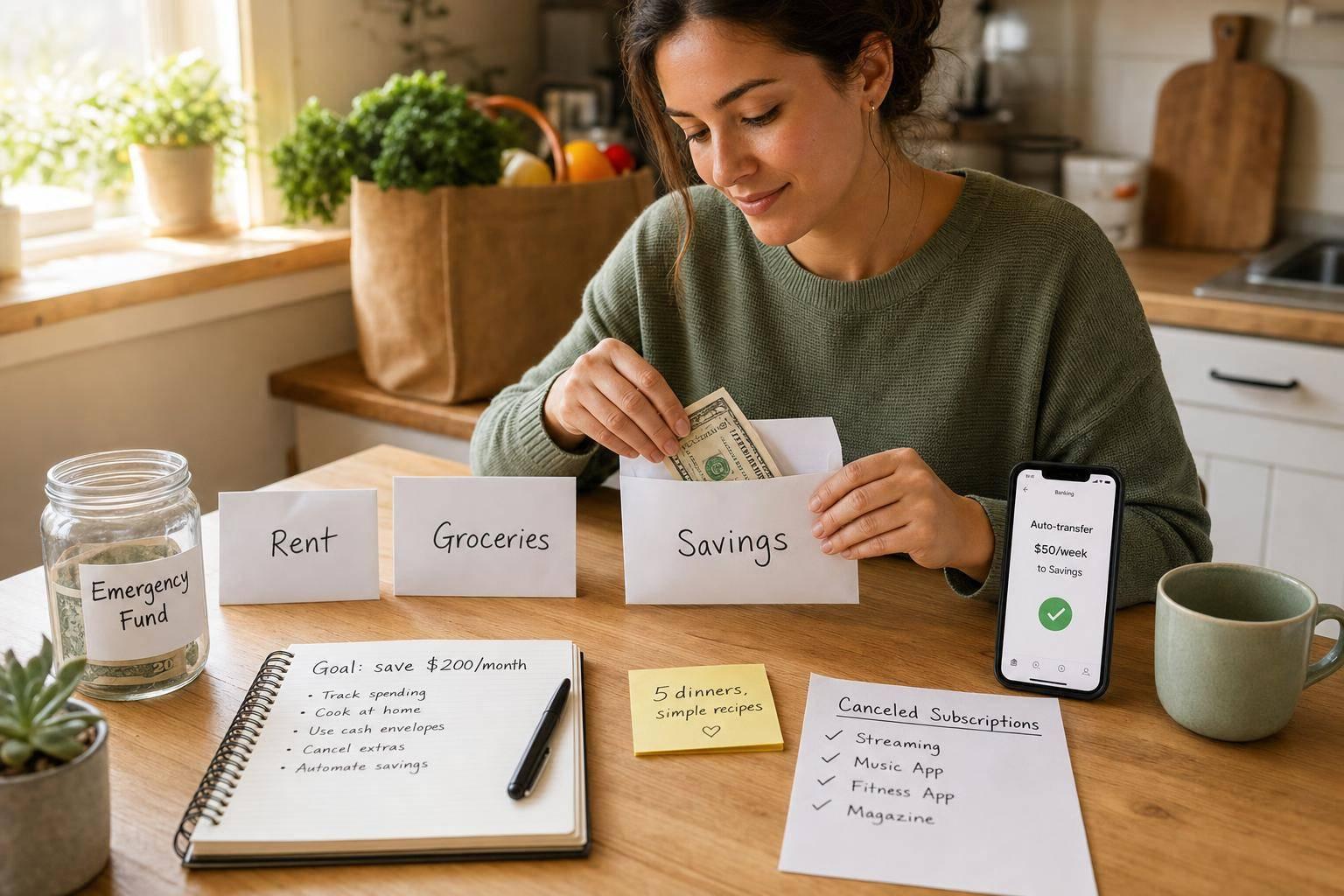
If money feels tight, I’d start with 3 moves: track every dollar for 30 days, cut unused subscriptions, and cap grocery and impulse spending. That alone can free up $100 to $300 a month for many people.
Here’s the short version: this article shows how I can save money by building a bare-bones budget, planning meals, buying store brands, lowering monthly bills, using cash limits, setting small auto-savings, selling stuff I don’t use, and putting extra cash toward high-interest debt. It also explains how a 20- to 30-minute monthly check-in helps keep those savings from slipping away.
The 10 ways covered are:
- Track spending with an app like Monefy
- Build a bare-bones budget
- Plan meals and shop with a list
- Buy generic brands and use store loyalty deals
- Cancel unused subscriptions
- Negotiate lower rates on phone, internet, insurance, and utilities
- Use cash envelopes or weekly spending caps
- Automate small savings transfers
- Sell unused items for extra cash
- Pay down high-interest debt with the money saved
| Strategy | Best for | How fast it can help |
|---|---|---|
| Tracking spending | Finding money leaks | This week |
| Bare-bones budget | Covering bills first | This month |
| Meal planning + grocery list | Cutting food costs | This week |
| Generic brands + loyalty deals | Lowering checkout totals | Right away |
| Canceling subscriptions | Trimming recurring charges | Right away |
| Negotiating bills | Lowering fixed monthly costs | In a few days |
| Cash envelopes/spending caps | Stopping overspending | Right away |
| Auto-savings | Building an emergency fund | With next paycheck |
| Selling unused items | Getting extra cash | In 1–7 days |
| Paying high-interest debt | Lowering interest costs | Right away |
Bottom line: I don’t need one big reset. I need a few small cuts, a clear plan, and a way to keep the money I save.
Start Here: Know Where Your Money Goes
Before you cut even one expense, you need to see exactly where your money is going. Most people know the big stuff like rent, groceries, and gas. But the smaller purchases? That’s where money tends to slip through the cracks.
Start with a 30-day spending log. Use Monefy to track every purchase for 30 days. Once you do, the biggest money leaks usually become easy to spot.
Monefy keeps daily tracking simple. You can log a purchase in seconds and check your spending at a glance without a lot of setup. The free plan covers the basics, and that’s enough to begin.
After your log fills up, the first places to cut usually become obvious. You’ll see the hidden spending: recurring charges, daily convenience buys, and forgotten memberships. And those are exactly what the next 10 strategies go after.
sbb-itb-02fd20a
1. Track Every Dollar With Monefy

Most people think they have a decent handle on where their money goes. Then they track it for a month and get a rude surprise.
On average, people underestimate daily spending by 20% to 30%. That gap can quietly eat into the money you need for rent, groceries, and bills. If your budget is tight, this matters a lot. The job here is simple: spot waste before it pushes out the basics.
Monefy helps by making each expense visible. Use categories to separate needs from wants. When you can see the leaks, it gets much easier to shut them down.
After 30 days of steady tracking, many people find $100 to $300 per month in hidden waste. That’s not small change. On a tight budget, that money can cover part of a utility bill, a grocery run, or a tank of gas.
Subscriptions are one of the biggest trouble spots. A 2025 survey found that the average American spends $329 per month on subscriptions but thinks they spend only $86. That’s a $243 gap.
Here’s a simple rule: after 30 days, cancel any subscription you didn’t use last month.
Once you know where the money is leaking, you can move on to a budget that leaves less to chance.
2. Build a Bare-Bones Budget
Once you’ve tracked your spending for 30 days, use those numbers to build a bare-bones budget. The goal is simple: give every dollar a job. That keeps your money pointed at the bills that matter most instead of drifting into spending that can wait.
Start with the basics first:
- Housing
- Groceries
- Utilities
- Transportation
Cover those before anything else. After that, make your minimum debt payments. If there’s money left, that’s when wants get a spot in the budget.
Use zero-based budgeting so every dollar of take-home pay is assigned before the month begins. It’s a plain, no-nonsense way to stay in control, especially when money feels tight.
On a tight budget, the usual 50/30/20 split often doesn’t fit. You may need to shift more money toward needs and trim the rest for now:
| Category | Standard 50/30/20 | Tight Budget |
|---|---|---|
| Needs (Housing, Food, Utilities, Transport) | 50% | 60–70% |
| Wants (Dining, Entertainment, Subscriptions) | 30% | 10–20% |
| Savings & Debt Repayment | 20% | 5–10% |
Build your budget using the lowest-earning month from the past six months. That gives you a safer baseline. Then, in months when you bring in more, send the extra money to savings or debt.
It also helps to rebuild your budget each month. Bills don’t always show up in neat, even patterns, and irregular expenses still land when they land. Setting aside small monthly amounts for those costs can keep them from throwing you off. Once your basics are covered, you can move on to cutting day-to-day food costs.
3. Plan Meals and Shop With a Grocery List
Shopping without a plan can add 20% to 40% to your grocery bill just from impulse buys. On the flip side, spending 15 minutes a week on meal planning and a grocery list can save $60 to $120 a month.
Start with what you already have. Check your fridge, freezer, and pantry before you write your list. Then plan this week’s meals around those items and buy only what’s missing. That simple step helps you avoid buying duplicates and cuts food waste. The USDA says the average American family throws away about $1,500 in food each year.
A simple way to do this is to plan 4–5 dinners a week and leave some room for leftovers and busy nights. It also helps to pick meals that use the same ingredients. For example, a bag of spinach can go into a salad one night and a pasta dish the next. You get more use out of what you buy, and less ends up in the trash. It also makes sense to build meals around this week’s sales.
A few small habits can trim your total at checkout:
- Don’t shop hungry. Hungry shoppers spend more on impulse foods.
- Stick to your list.
- If aisle temptations get you every time, try grocery pickup. Shoppers who order online for pickup spend 15% to 25% less per trip because they avoid in-store impulse triggers.
Once your grocery list is lean, lower the cost of each item by choosing generic brands and store deals.
4. Buy Generic Brands and Use Store Loyalty Deals
Store brands are often 15% to 30% cheaper than name brands. That gap may not look huge at first, but across a full cart, it adds up fast.
A good place to start is with basic pantry items. Think flour, sugar, salt, and baking soda. These products use the same core ingredients as name brands. The same goes for dairy basics like milk, eggs, butter, and shredded cheese, plus canned goods and frozen vegetables.
Over-the-counter medications are another easy swap. Generic medications must meet the same FDA safety and efficacy standards as name brands, and they often cost 80% to 85% less. That's a massive price gap for something held to the same rules.
These swaps can trim a lot from weekly staples:
| Item | Name Brand | Store Brand | Savings |
|---|---|---|---|
| Whole Wheat Bread (20 oz) | $5.80 | $3.00 | 48% |
| Eggs, Large (Dozen) | $5.50 | $3.50 | 36% |
| Peanut Butter (16 oz) | $4.50 | $2.80 | 38% |
| All-Purpose Flour (5 lb) | $4.50 | $3.00 | 33% |
| Pasta, Spaghetti (16 oz) | $1.80 | $1.10 | 39% |
You can save even more by layering store deals on top of the lower shelf price. Store loyalty programs often include digital coupons and member-only discounts worth 5% to 10%. In many grocery chains, you need a loyalty membership to get those discounts at checkout. Active Kroger loyalty users save an average of $15 to $25 per month.
Before heading to the store, open the app and clip that week's digital deals. Then, if the store allows it, stack a cashback app on the same purchase. It's one of those small habits that takes a minute and can shave a few more dollars off the total.
Name brands can still make sense in a few spots, like trash bags, paper towels, and concentrated dish soap. But for most staples, generic usually gives you the better deal.
5. Cancel Unused Subscriptions and Memberships
Subscription costs are easy to shrug off because each charge looks small on its own. But they add up fast. In a 2024 study, Americans guessed they spent $111 a month on subscriptions, while the actual total was $273. That’s a $162 gap quietly taking money out of every paycheck.
Start with a simple check: review the last 90 days of bank and credit card statements. Then look at app-store subscriptions, Amazon memberships, and email receipts for recurring charges.
If you haven’t used something in the last 90 days, cancel it. You can always sign back up later if you miss it and still use it enough to make the cost worth it. A good example is streaming. Instead of paying for several at once, keep one service at a time and switch month to month.
Paid AI tools can slip under the radar too. A few plans here and there can quietly cost $20 to $60 or more each month. In most cases, one paid plan is enough, and free tiers can cover the rest.
| Subscription Category | Potential Monthly Savings | Alternative |
|---|---|---|
| Stacked Streaming | $30–$50 | Rotate one service per month |
| AI Tools | $20–$60 | Pick one premium tool; use free tiers for others |
| Gym Membership | $40–$90 | YouTube workouts or a $10/month basic gym |
| News & Media | $10–$17 | Free library access via Libby or PressReader |
| Delivery (DashPass, Uber One) | $10–$15 | Switch to pickup orders |
One small trick can save you from an annoying charge later: cancel free trials the same day you sign up. You still keep the trial access, but you remove the risk of an auto-renewal hitting your account.
After you cut back subscriptions, fixed monthly bills are often the next place where the biggest savings show up.
6. Negotiate Lower Rates on Phone, Internet, Insurance, and Utilities
After you cut subscriptions, the next place to look is your fixed monthly bills. This is where some of the biggest savings tend to show up. Phone, internet, insurance, and utility costs can often drop with one phone call. Many households save $300 to $600 per year by negotiating recurring bills.
Before you call, use your spending log to spot every recurring charge. That step matters. If you miss a bill, you miss a chance to save.
Also, don’t waste too much time with the first person who answers. Frontline reps often can’t give strong discounts. Ask to be transferred to the retention or cancellation team right away. Say: "I'm considering canceling and would like the retention team." That usually gets you to the right department faster.
Have your homework ready before you pick up the phone. Pull up your last three statements and write down:
- Your current monthly price
- Your plan name
- Any promo end dates
- Your history of on-time payments
Then check your provider’s website and see what new customers get for the same package. That gap is your leverage. If a new customer can get a lower price, bring it up and ask the company to match it or beat it. For internet service, FCC Broadband Labels can help you compare the full price and data caps in a more objective way.
Timing helps too. Call Tuesday through Thursday, 9:00–11:00 a.m.. You’re more likely to reach someone who can work through the request without the usual rush.
Here’s a realistic snapshot of what one round of calls can save:
| Bill Type | Typical Monthly Savings | Realistic Annual Savings |
|---|---|---|
| Internet/Cable | $20 – $40 | $240 – $480 |
| Cell Phone Plan | $10 – $30 | $120 – $360 |
| Auto Insurance | Varies | $200 – $500 |
If the first offer is weak, push a little. Ask whether they can get closer to the competitor’s rate. Then ask for written confirmation of the new price, the start date, the term, and the reference number. That way, you’re not left guessing later. Once those bills come down, lock down the extra cash so it doesn’t quietly disappear into day-to-day spending.
7. Use Cash Envelopes or Weekly Spending Caps
Once your fixed bills are paid, the next job is keeping variable spending in check. That’s the part of the budget that tends to eat up what’s left of your paycheck. Groceries, gas, and dining out are often where things go off track.
Cash envelopes put a firm limit on that spending.
At the start of the week, withdraw a set amount of cash and divide it into labeled envelopes like Groceries, Gas, and Eating Out. When an envelope is empty, spending in that category stops.
That’s the whole point: cash feels more final. It’s easier to notice when money is leaving your hands, and that friction helps. People usually spend 10% to 20% less with cash than with cards, and the cash envelope method can save $40 to $80 a month on groceries.
If carrying cash feels like a hassle, use the same idea with a spending cap in your budget app. For groceries, a good starting point is $60–$80 per person each week to help avoid extra takeout spending. Log every cash purchase in Monefy right away so your cap stays accurate. Once you hit the limit, pause spending in that category until next week.
8. Automate Small Savings Transfers
Once you put a cap on spending, the next step is making sure the money that's left doesn't quietly disappear. That's where automation helps. If you try to save whatever remains at the end of the month, you’ll often find there’s nothing left. A small automatic transfer works better, even if you start with just $5 or $10 per paycheck.
The best setup is to split your direct deposit through payroll so part of your pay goes straight into savings. If your employer doesn’t offer that, set up a recurring bank transfer for the morning after payday, once your deposit has cleared.
Keep that money in a separate high-yield savings account. As of June 2026, top-tier HYSAs offered 4.00% APY or more, compared with a 0.41% national average. That gap is hard to ignore. It also helps to keep the account separate from your main checking account and skip the debit card, so pulling money out takes a little more effort. Even naming the account something like Emergency Fund Only can help keep you on track.
The math gets encouraging fast. Saving $10 a week adds up to $520 in a year, and people who save with automation tend to build much more than people who try to do it by hand. When the habit starts to feel easy, bump your transfer up by 1% of your paycheck every 90 days so the change doesn’t sting.
Once savings run on autopilot, the next fast win is turning unused items into cash.
9. Sell Unused Items for Quick Cash
Most homes are sitting on $3,100–$5,300 worth of unused stuff, and many households can bring in $100–$800 by selling a few things they no longer use. Even a small cleanout can turn into extra cash.
A good place to start is old electronics. Older smartphones can sell for $50–$300, depending on the model and condition. Services like Gazelle and Decluttr offer instant quotes and can send payment within 1–5 days after they get your device. And yes, even damaged devices may still be worth something if they power on.
Use the platform that fits the item best. That can make the sale move a lot faster.
| Platform | Best For | Payout Speed | Seller Fee |
|---|---|---|---|
| Facebook Marketplace | Furniture, household items | 1–3 days | 0% (local pickup) |
| Poshmark | Clothing and accessories | 3–5 days after sale | 20% (sales over $15) |
| eBay | Electronics, collectibles | 3–7 days | 12.9%–15% |
| Decluttr | Tech, DVDs, books | 1–2 days after receipt | 0% (direct buy) |
| Gazelle | Smartphones and tablets | About 5 days after receipt | 0% (direct buy) |
If you want items to move fast, price them at 30%–50% of the original retail price. Take photos in natural light with a clean background. That small step matters more than people think. Items with clear, detailed photos sell up to three times faster than items with poor images.
Before you post anything, check Sold listings on eBay or Facebook Marketplace instead of looking at asking prices. That shows what buyers are actually paying, not what sellers hope to get.
Once the money comes in, put it toward your high-interest debt right away.
10. Put Extra Money Toward High-Interest Debt
Once you’ve freed up cash in the earlier steps, put that money to work on debt. Send any extra dollars from side savings straight to high-interest balances before they drift back into day-to-day spending. Credit card balances often come with an APR of 20% to 30%, so carrying a balance can quietly eat away at your budget month after month.
Even small extra payments help. They cut down the principal, which means you’ll pay less interest later.
If you’re dealing with more than one balance, choose a payoff order and stick with it. You can use the Avalanche method to pay less interest overall or the Snowball method if you want momentum from early wins. The best method is the one you’ll keep using.
Before sending extra payments, call your credit card issuer and ask for a lower rate. It’s worth the few minutes. Research shows that 76% of cardholders who ask for an APR reduction get one. The average drop is 6 percentage points. On a $3,500 balance, that works out to about $210 per year in interest savings alone.
When you pay off one balance, roll that full payment into your next debt or your emergency fund. That way, the money you’ve freed up doesn’t slip through the cracks again.
Where Each Strategy Saves You the Most
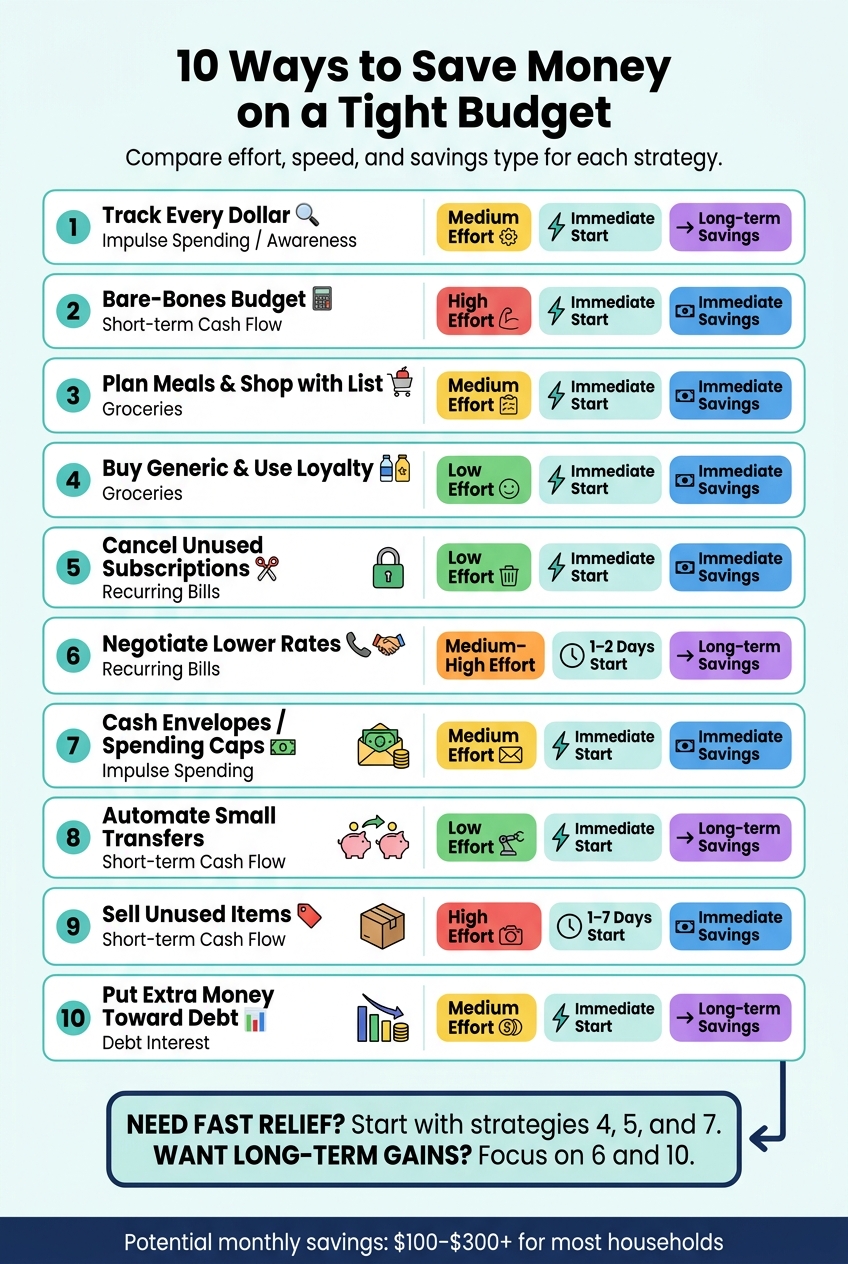
10 Ways to Save Money on a Tight Budget: Effort, Speed & Savings
Each move trims a different expense. Some help right away. Others pay off little by little over time. That matters, because the best first step depends on what’s squeezing your budget the most.
Use this table to pick the first two actions that make the most sense for you.
| Strategy | Savings Category | Effort Level | Time to Start | Savings Type |
|---|---|---|---|---|
| 1. Track Every Dollar | Impulse Spending / Awareness | Medium | Immediate | Long-term |
| 2. Bare-Bones Budget | Short-term Cash Flow | High | Immediate | Immediate |
| 3. Plan Meals & Shop with List | Groceries | Medium | Immediate | Immediate |
| 4. Buy Generic & Use Loyalty | Groceries | Low | Immediate | Immediate |
| 5. Cancel Unused Subscriptions | Recurring Bills | Low | Immediate | Immediate |
| 6. Negotiate Lower Rates | Recurring Bills | Medium–High | 1–2 Days | Long-term |
| 7. Cash Envelopes / Spending Caps | Impulse Spending | Medium | Immediate | Immediate |
| 8. Automate Small Transfers | Short-term Cash Flow | Low | Immediate | Long-term |
| 9. Sell Unused Items | Short-term Cash Flow | High | 1–7 Days | Immediate |
| 10. Put Extra Money Toward High-Interest Debt | Debt Interest | Medium | Immediate | Long-term |
If you need relief fast, start with 4, 5, and 7. Those can free up money without much delay. If you want gains that build over time, put your energy into 6 and 10.
Next, use the monthly check-in to keep these savings from slipping away.
Do a Monthly Check-In to Keep Savings on Track
Once you’ve cut costs, set aside 20–30 minutes each month to make sure those savings still show up. The goal is simple: catch small issues before they turn into bigger ones.
Start with your recurring charges. Open Monefy and review your Bills category. Make sure the subscriptions you canceled last month are still gone. Then check that any bills you negotiated are still coming through at the lower rate.
Next, compare variable spending from one month to the next. Focus on categories like groceries, dining out, and convenience purchases. Those little repeat charges - coffee, delivery fees, and quick impulse buys - can sneak up on you and add $50 to $150 per month. With Monefy's expense categories, you can look at your actual spending and spot patterns fast.
Finally, move the savings right away. If canceling a subscription saved you $15 or a bill cut saved you $20, transfer that exact amount to your emergency fund or put it toward high-interest debt before it disappears into day-to-day spending. A good first target is a $500–$1,000 starter emergency fund so one surprise bill doesn’t send you back into debt. After that, put the money where it can do some work.
A monthly check-in helps keep your savings from quietly sliding back into spending.
Conclusion
Saving money on a tight budget doesn't come from one big reset. It comes from small moves you can repeat until they start to stick.
A lower grocery bill, fewer forgotten subscriptions, and automatic transfers into savings can make a clear difference. You don't need more income to get started. You need a plan, a few targeted cuts, and the follow-through to keep them going.
Start with one change this week. Add another next month. That's how small cuts turn into money you can keep.
Track what leaves your account, cut the leaks, and lock in the savings. With steady tracking and a few smart adjustments, a tight budget can start to feel a little less tight.
FAQs
What should I cut first on a tight budget?
Start with costs that won’t change your day-to-day life before you touch basics like housing and food.
Begin by canceling unused subscriptions, streaming services, or memberships. Next, get rid of avoidable fees, like overdraft charges or paper statement fees. Then call and try to lower fixed bills such as insurance or internet. After that, trim variable spending like dining out.
How much should I save if I can only afford a little?
When money is tight, the exact amount matters less than building the habit. You can start small - just $5 to $10 per paycheck is enough to get going.
Set up an automatic transfer on payday so the money moves before you have a chance to spend it. That small step can make saving feel almost effortless. It also gives you room to stick with the habit, bump up the amount over time, and work toward a $500 to $1,000 emergency fund.
Should I save money first or pay off credit card debt first?
Build a small emergency fund of $500 to $1,000 first.
That money gives you a little breathing room when life throws a surprise your way, like a car repair or a medical bill. Without that cushion, it’s easy to fall back on a high-interest credit card and end up paying far more than the original cost.
Once you’ve set that aside, turn your attention to high-interest debt. A good place to start is with revolving balances that carry an APR above 15%.
Why begin there? Because those balances tend to rack up interest fast, which means they cost you more the longer they stick around.