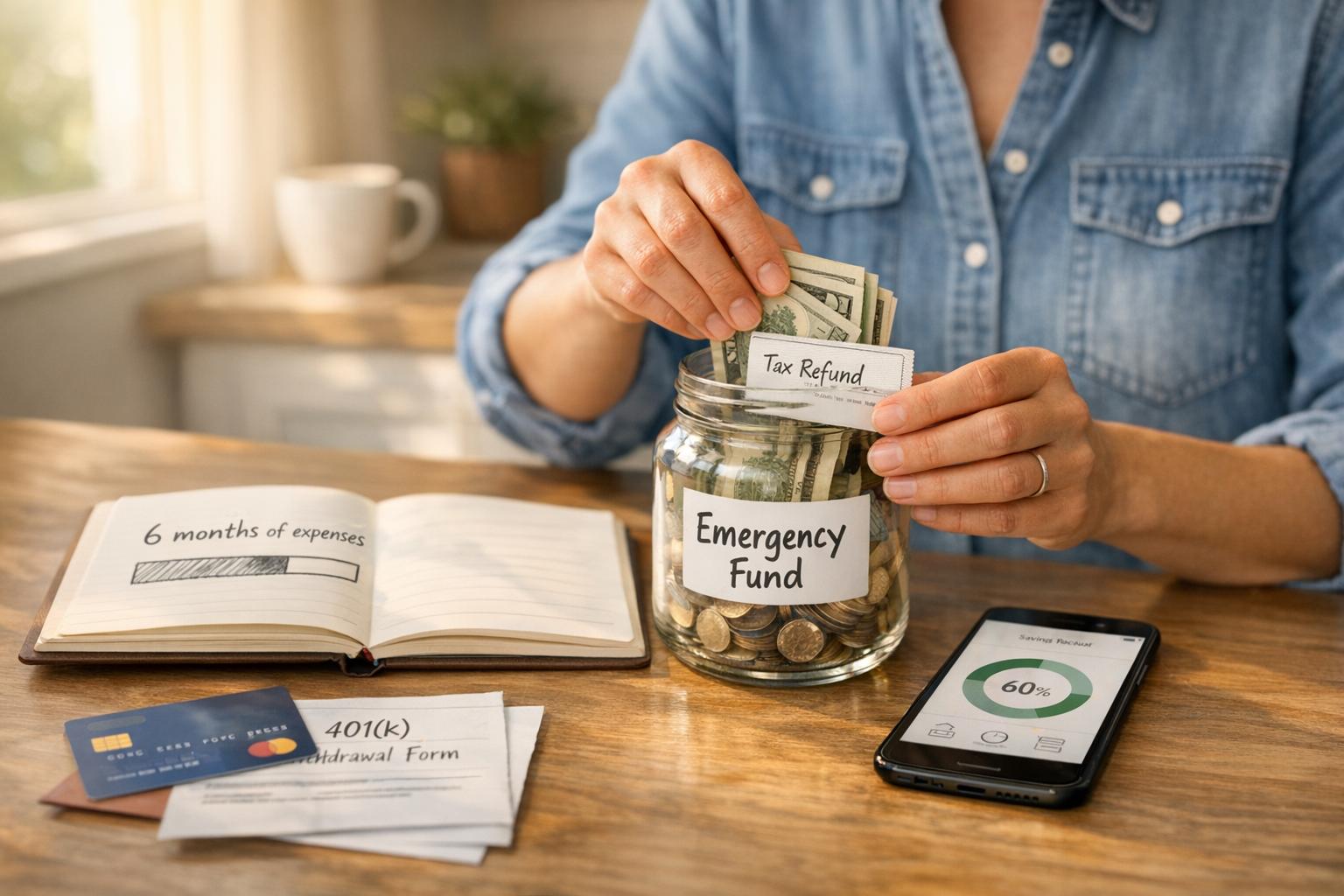
Rebuilding an emergency fund can feel overwhelming, but avoiding common mistakes can make the process smoother and faster. Here's what you need to know:
- Don’t withdraw from retirement accounts: Early withdrawals come with penalties, taxes, and lost future earnings.
- Avoid relying on credit cards: High-interest rates can trap you in debt, making recovery harder.
- Set realistic savings goals: Overly aggressive targets can lead to burnout and discourage progress.
- Track your savings progress: Without monitoring, small expenses can derail your efforts.
- Use windfalls wisely: Bonuses, tax refunds, or side hustle income should go directly into your emergency fund.
Key Tip: Start small, automate savings, and use a high-yield savings account to grow your fund without risking accessibility. Rebuilding takes time, but steady progress ensures success.

Emergency Fund Recovery: 5 Common Mistakes and Solutions
Mistake 1: Withdrawing from Retirement Accounts
When unexpected expenses pile up and your emergency fund runs dry, dipping into your 401(k) or IRA can feel like an easy way out. But this move can seriously harm your financial future. Nearly 40% of people tap into their retirement accounts early, and in 2023, about one-third of workers cashed out their 401(k) plans when leaving their jobs.
Withdrawing from these accounts before age 59½ comes with hefty consequences. There’s a 10% federal tax penalty, plus you’ll owe income taxes at your marginal rate. For instance, if you earn $75,000 and withdraw $25,000, you could end up paying around $5,500 in federal income tax and a $2,500 penalty - roughly $8,000 in total costs. On top of that, taking a large withdrawal might push you into a higher tax bracket. And unless you roll the funds directly into an IRA, your plan will withhold 20% for federal taxes automatically.
Adam Wojtkowski, CFP and Founder of Copper Beech Wealth Management, explains the surprise factor:
"Whatever [people] are cashing out, it's hitting their ordinary incomes. I would imagine, for a lot of people, that it would probably be a pretty surprising tax bill come tax time the following year."
The financial hit doesn’t stop there. Early withdrawals also mean losing out on the power of compounding. For example, a $5,000 withdrawal at age 30 could grow to almost $74,000 by age 65 with an 8% annual return. That’s $69,000 in potential future wealth gone. Jason Siperstein, CFP and President of Eliot Rose, puts it bluntly:
"I almost never recommend that someone cash out a 401(k)... You're solving a problem today, but creating a much larger one tomorrow."
If you want to protect your retirement and still cover emergencies, it’s crucial to explore other financial options.
Solution: Focus on Liquid Savings Options
Instead of pulling from your retirement funds, look into liquid savings accounts like high-yield savings, money market accounts, or cash management accounts. These options keep your money accessible and penalty-free while offering FDIC or SIPC protection. While they won’t grow your wealth significantly, they provide a reliable safety net for emergencies without jeopardizing your retirement goals.
If you absolutely must access your retirement funds, consider a 401(k) loan instead of a withdrawal. You can borrow up to 50% of your vested balance or $50,000 (whichever is less), and as long as you repay it within five years, you’ll avoid taxes and penalties. However, be cautious - if you leave your job, many plans require you to repay the loan in full immediately.
Starting in 2024, the SECURE 2.0 Act introduces a penalty-free $1,000 emergency withdrawal option for "unforeseeable or immediate financial needs." You can take out up to $1,000 per year and, if you repay it within three years, recover the income taxes paid. While this won’t fully replace an emergency fund, it’s a safer option than a full withdrawal.
To rebuild your emergency savings, take a closer look at your spending. Tools like Monefy can help you track your expenses, pinpoint areas to cut back, and redirect those savings toward a dedicated emergency fund. This way, you can handle unexpected costs without putting your retirement at risk.
sbb-itb-02fd20a
Mistake 2: Using Credit Cards as Your Primary Recovery Method
When your emergency fund runs dry, it might feel natural to turn to credit cards for unexpected expenses. But relying on high-interest credit can lead to a financial snowball effect that's tough to escape. In 2024, the average credit card interest rate hit 22.77% - a staggering figure that can make even small charges grow into major burdens over time.
Let’s break it down: imagine a $3,000 emergency expense charged to a card with a 23% APR. If you only make the minimum payment of $90 per month, it’ll take 52 months to pay off, and you’ll rack up $1,680 in interest. That’s more than half the original amount! As ASAP Credit Repair puts it:
"The difference between using savings and using credit is the difference between solving a problem and creating a bigger one."
On top of that, high credit card balances can harm your credit score. Credit utilization - how much of your available credit is being used - accounts for 30% of your overall credit score. If your utilization creeps above 30%, it’s a red flag for credit bureaus, potentially dropping your score by 50–80 points. Plus, when you’re funneling money into paying off credit card debt, you’re left with less to rebuild your emergency fund, making it harder to prepare for future surprises. This creates a vicious cycle that’s tough to break.
Solution: Limit Credit Card Use and Create a Payoff Plan
Credit cards should only be a last resort, not your go-to solution. If you must use one in an emergency, try to minimize the amount you charge. For instance, if an unexpected $3,000 expense arises, use $1,500 in cash and charge the remaining $1,500 - this approach reduces both your debt and the interest you’ll owe. Always opt for the card with the lowest APR, or explore alternatives like a personal loan from a credit union, which may offer rates under 10%.
The Consumer Financial Protection Bureau emphasizes:
"Paying more than the minimum is the single most effective way to reduce credit card debt."
Aim to clear the balance within 12–18 months. For example, paying $200 per month on a $3,000 balance at 23% APR can wipe out the debt in 18 months, with about $700 in interest - saving you nearly $1,000 compared to making only minimum payments.
While tackling your debt, don’t neglect your emergency fund. Set up automatic transfers of $50–$100 from each paycheck into a high-yield savings account. This way, you’re steadily rebuilding your safety net while paying down your credit card balance. To avoid slipping into new debt, use budgeting tools like Monefy to track your spending and identify areas where you can cut back. A balanced approach ensures you’re prepared for the next curveball life throws your way.
Mistake 3: Setting Goals That Are Too Aggressive
When your emergency fund runs dry, the urgency to rebuild it can push you toward setting overly ambitious goals. Deciding to save $500 or $1,000 a month while struggling to cover basic expenses can quickly lead to burnout. Big, intimidating goals often create a mental block, making it hard to even begin. Personal finance writer Evelyn Waugh highlights this challenge:
"If you try to leave yourself with no money whatsoever for enjoyment in order to salt away as much as possible, you'll likely struggle to stick with your plan."
This isn’t just about willpower - it’s about creating a plan you can stick with. A savings strategy that doesn’t allow for basic needs or occasional small indulgences is hard to maintain. Falling short of an unrealistic target can leave you feeling defeated.
Experts recommend a gradual approach. Start small by building a starter fund of $500 to $1,000 to handle immediate, unexpected costs. Achieving this manageable goal gives you a quick win and builds confidence. From there, work toward saving one month’s worth of expenses, then three months, and eventually the recommended 3–6 months of coverage. Keep in mind, as of 2024, only 55% of adults had enough savings to cover three months of expenses. You’re not alone in starting over, and taking it step by step can help ease the financial and emotional burden.
Solution: Set Achievable Targets and Increase Over Time
Start small. For example, save $20 to $30 from each paycheck. If that feels like too much, try saving $25 per week. Over the course of a year, that adds up to about $1,300. Increase it to $50 per week, and you’ll have roughly $2,600 by year’s end. The key here is consistency, not the size of the contribution. Jason Fannon, Senior Partner at Cornerstone Financial Services, offers this practical advice:
"Automation lets the money move before you can talk yourself out of it."
Set up automatic transfers to a high-yield savings account right after payday. This way, you don’t have to rely on willpower - the money is saved before you even notice it’s gone. To stay on track, use tools like Monefy to monitor your progress. The app’s visual charts and categories make it easy to see how your savings grow, and you can add personal notes like "Auto-transfer" or "Bonus allocation" to identify what’s working best for you.
Break your savings journey into clear milestones: start with $500, then aim for $1,000, followed by one month’s expenses, and finally 3–6 months of coverage. Celebrate each milestone, even with something as simple as a note in your tracking app acknowledging your progress. Rebuilding your emergency fund is a long-term effort, and slow, steady progress will always outlast overly aggressive goals. Up next, discover how tracking your savings can help strengthen your financial recovery.
Mistake 4: Failing to Monitor Your Savings Progress
Rebuilding an emergency fund without keeping track of your progress is like driving without a map - you might end up going in circles. Monitoring your savings is just as important as choosing the right strategies to build them. Unfortunately, many people set vague goals and don’t follow through with tracking, leading to stalled progress or even dipping into their emergency funds unintentionally.
The statistics are a wake-up call. As of May 2025, only 63% of U.S. adults could handle a $400 emergency expense with cash. Even more concerning, about 24% of consumers have no savings at all for unexpected situations. Without tracking, small, seemingly harmless expenses - like unused subscriptions, delivery fees, or impulse buys - can quietly drain your savings before they even have a chance to grow. These "micro-leaks" can add up fast.
When you don’t monitor your savings, it’s easy to lose accountability. You might find yourself using the fund for non-essentials, blurring the line between true emergencies and everyday wants. Tracking helps you stay disciplined, ensuring your fund is reserved for its intended purpose.
There’s also a motivational aspect. Building an emergency fund takes time, and without visible progress, it’s easy to lose steam. Watching your balance grow with each contribution - whether it’s a portion of your paycheck or a bonus - can keep you motivated and focused. To avoid stalling, it’s essential to establish a clear system for tracking your progress.
Solution: Track Progress with Budgeting Apps
To make sure every dollar you save contributes to your emergency fund, use budgeting tools to stay organized. Create a dedicated "Emergency Fund" category in a budgeting app like Monefy. This keeps your savings separate from your regular spending and allows you to see your progress at a glance. When you add money to the fund, include notes like "Tax refund" or "Paycheck auto-transfer" to understand which methods are most effective.
Breaking your goal into smaller milestones can also help you stay motivated:
| Milestone | Target Amount | Purpose |
|---|---|---|
| Starter Fund | $500 - $1,000 | For minor repairs or medical copays |
| Foundation | 1 Month Expenses | Basic buffer for small income disruptions |
| Full Coverage | 3 - 6 Months Expenses | Protection against job loss or major crises |
Set up automated transfers on payday to make saving effortless. Log each contribution immediately to track your progress in real time. Use Monefy’s charts to get instant visual feedback on how your fund is growing. To prevent unnecessary withdrawals, follow a 24-hour rule: before taking money out, write down your reason and wait a day. Review your balance monthly to spot any issues early, keeping your emergency fund on track to become a reliable safety net.
Mistake 5: Not Using Bonuses and Extra Income
When a tax refund, work bonus, or payment from a side hustle hits your account, it’s easy to feel like you’ve earned a little splurge. But letting those extra funds disappear too quickly can delay the process of rebuilding your emergency fund. For perspective, the average IRS tax refund in 2025 was $3,167 - a sum that could take you from a starter fund to a more secure financial cushion. Yet, only 41% of American adults reported being able to cover a $1,000 emergency expense from their savings. Without a solid emergency fund, unexpected expenses like car repairs or medical bills can push you into relying on credit cards, which often come with interest rates averaging over 22%.
Melissa Joy, CFP and President of Pearl Planning, highlights the risk of being unprepared for the unexpected:
"One of the biggest threats to financial security is unexpected expenses".
Using windfalls to build your emergency fund can help you avoid debt cycles and protect your investments. For example, if you’re saving $200 a month, it would take about 12.5 months to reach a $2,500 emergency fund. But a single $3,167 tax refund could get you there instantly. Nathaniel Hoskin, Founder and Lead Advisor for Hoskin Capital, emphasizes the importance of this safety net:
"Having a backup plan means that you can stay invested when times get tough".
With an emergency fund in place, you’re less likely to dip into retirement accounts or sell investments at a loss during financial hardships.
Redirecting windfalls to your emergency fund not only strengthens your financial security but also prevents short-term indulgences from derailing your long-term goals. Paul Sundin, CPA and Tax Strategist at Estate CPA, advises:
"As tempting as it may be to use the money to treat yourself, you shouldn't. If you keep it up, you'll be surprised at how fast you can replenish your savings".
Every bonus, cash gift, or cashback reward is an opportunity to make meaningful progress toward your savings goals.
Solution: Allocate Windfalls Directly to Your Emergency Fund
To make the most of these financial boosts, transfer them to your high-yield savings account as soon as they arrive. Acting quickly reduces the temptation to spend the money elsewhere. A helpful strategy is the 50% rule: allocate at least half of any windfall to your emergency fund, while allowing yourself a small reward - say, 10% - to stay motivated.
Tracking these contributions can also keep you accountable. Use tools like Monefy to create a dedicated income category for windfalls. Add notes with labels like "Q1 Performance Bonus", "Tax Refund 2026", or "Freelance Project Payment" to see how these one-time boosts accelerate your savings compared to regular monthly deposits.
Don’t underestimate smaller windfalls either. Cashback rewards, gift money, or side hustle earnings might seem minor, but they add up over time. Log every contribution within 24 hours of receiving it to maintain momentum. By planning your allocation in advance, you’ll be ready to direct these extra funds toward your emergency fund the moment they hit your account.
Selecting the Right Account for Your Emergency Fund
Where you decide to keep your emergency fund can be just as crucial as the amount you save. Choosing the wrong account might mean forfeiting hundreds of dollars in interest or struggling to access your money when you need it most. For example, traditional checking accounts typically offer a meager 0.07% APY, while savings accounts at many big banks only provide between 0.01% and 0.05%. On the other hand, high-yield savings accounts can deliver interest rates that are 80 to 500 times higher. These stark differences highlight why selecting the right account is so important - it needs to grow your savings while remaining easily accessible.
An effective emergency fund account should meet three key criteria: penalty-free access, insurance coverage (FDIC or NCUA) up to $250,000, and separation from your day-to-day spending accounts. Accounts that charge maintenance fees or require high minimum balances can quickly eat into your savings, especially after making a withdrawal during an emergency.
Joel O'Leary, a personal finance writer for Motley Fool Money, captures this balance perfectly:
"An emergency fund has three jobs: be accessible, be safe, and earn enough interest to keep up with inflation".
Consider this example: A $10,000 emergency fund in a high-yield savings account earning 4.5% APY would generate approximately $450 in interest annually. Compare that to a traditional savings account with a 0.01% APY, which would earn just $1. The difference is staggering.
Solution: Use High-Yield Savings Accounts
High-yield savings accounts check all the boxes for an ideal emergency fund. They combine safety, accessibility, and growth, offering APYs between 4.00% and 5.00%. These accounts also come with FDIC protection and liquidity similar to traditional savings accounts. Many online-only banks, which save on costs by not operating physical branches, pass those savings on to customers in the form of higher interest rates.
When choosing an account, look for features like same-day transfers to a linked checking account or ATM access for immediate cash needs. Stay away from accounts that lure you in with short-term promotional rates; instead, choose banks known for offering consistently competitive APYs. It’s also a good idea to review your rate every quarter, as online banks often adjust rates based on changes from the Federal Reserve.
To grow your emergency fund steadily, set up automatic monthly transfers. You can also link your high-yield savings account to tools like Monefy to track your balance and monitor your progress toward covering three to six months of expenses in real time.
Wrapping It Up
Rebuilding your safety net doesn’t have to feel overwhelming. By addressing the five common mistakes - such as dipping into retirement accounts, overusing credit cards, setting impractical goals, skipping progress checks, and wasting unexpected income - you can speed up your recovery and regain control over your finances.
Here’s the key: steady progress beats short bursts of effort. Research shows that most people can restore a six-month emergency fund in just over a year with consistent, deliberate saving. The trick is to create a system that simplifies the process and keeps you accountable. Financial coach Netta Stahl offers this practical advice:
"Rebuilding requires intentional budgeting. Sticking with old spending patterns while trying to replenish the fund will only slow progress".
Tools like Monefy can make tracking your finances easier. You can set up specific categories for your emergency fund, attach notes to contributions (e.g., "Tax refund allocation"), and monitor your progress in real time.
If you’ve had to use your emergency fund, that’s a sign it served its purpose. The next step is where the real work begins: putting a clear replenishment plan in place. Whether that’s saving an additional $100 each week for 10 weeks or allocating half of your next bonus, having a structured timeline helps you avoid falling back into financial instability.
Start today: automate your savings, park your money in a high-yield account, and track every dollar you save. With the right tools and habits, you’ll rebuild your financial safety net faster than you think and set the foundation for a more secure future.
FAQs
How do I rebuild my emergency fund if I’m also paying off debt?
To rebuild your emergency fund while tackling debt, start by setting a modest savings target - say, $1,000 - and automate regular transfers to a high-yield savings account. Keep an eye on your spending to identify and cut back on non-essential expenses. When you receive extra money, like a tax refund or a bonus, channel it into your savings. You could also consider picking up a side gig to increase your income. By automating your savings and being intentional with your spending, you can work toward rebuilding your fund while staying on top of your debt.
What counts as a real emergency vs. something I should budget for?
Unexpected situations like medical bills, car repairs, or losing your job can shake up your financial stability - that's what a real emergency looks like. These are the moments your emergency fund is meant to handle. On the flip side, expenses like vacations or buying the latest gadgets aren't emergencies. They're predictable and something you can plan for in your budget. The key is to reserve your emergency fund for life’s surprises, while setting aside separate savings for planned purchases.
How much should I keep in my emergency fund if my income is irregular?
If your income varies, start by saving at least $1,000 as an initial goal. Once you've hit that milestone, work toward building a fund that can cover 3–6 months of essential expenses. Breaking it down into smaller, more manageable targets - like saving $500 or $1,000 at a time - can make the process feel less overwhelming. Over time, this approach creates a dependable safety net for your basic needs, giving you more stability during unpredictable income periods.